
When building or restructuring a web project, whether it is an e-commerce platform, a content hub, or an institutional website, a fundamental question should emerge even before the first line of code is written or the first article is published:
How do we organize the information we need to put online?
The semantic era on the web began when Google launched BERT, and since that moment we have faced a dilemma in information organization: the base versus the top.
This challenge, although it may seem purely technical, lies at the core of user experience, content strategy, and, increasingly, success in SEO. The way we structure information on a website not only makes it easier for users to find what they are looking for, but also helps algorithms, such as Google’s, understand the depth and authority of our domain over specific subjects.
To choose a side in our dilemma, there are two opposing strategies, two philosophical lenses through which we can approach information architecture: the top-down approach and the bottom-up approach. This choice is not trivial or easy to make, as it carries profound and direct implications that shape everything from the creation of the site’s taxonomy to how we organize content production, substantially impacting the effectiveness and efficiency of your Semantic SEO strategy.
The top-down strategy: building from general to specific
The top-down approach represents the most classic and perhaps most intuitive method of information organization. It starts from a macroscopic or panoramic view of the knowledge domain to which the website belongs.
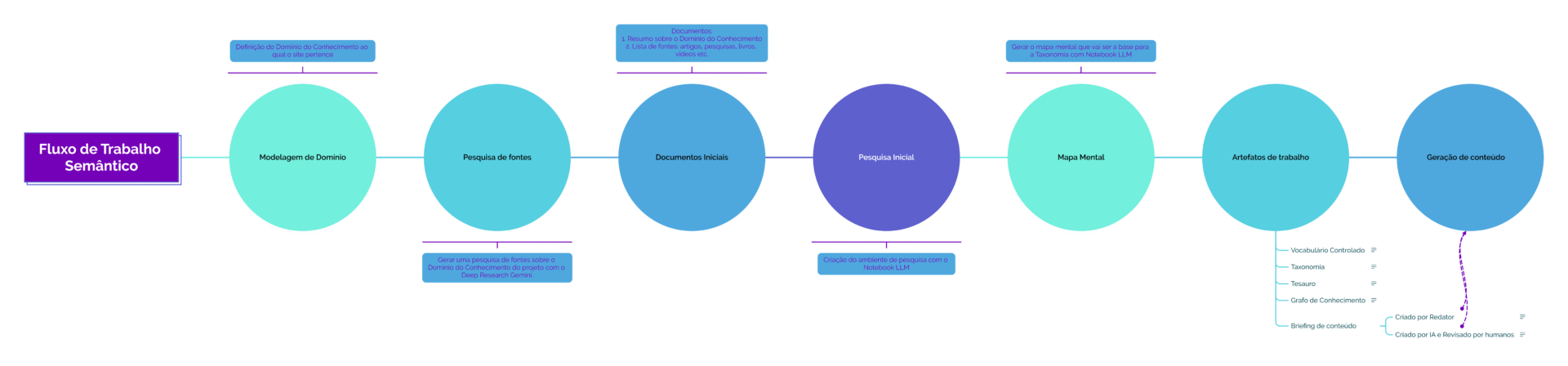
The process starts with Domain Analysis and then proceeds with the definition of the broadest and main categories, the major conceptual pillars that will sustain the entire structure, selected by the team developing the project. I must make it clear that this is an exercise in planning and anticipation, where information architects, SEO specialists, and content strategists first sketch the website’s information skeleton, establishing the “continents” before worrying about the “countries” and “cities”.
However, this process needs to involve everyone in the organization that owns the project to avoid the risk of creating an initial map with a biased view of the field of knowledge it belongs to.
In the image below, we have the first part of the Semantic Workflow, which begins precisely with this analysis due to its recognized importance.
Only after this high-level structure is solidified does the work move down to subcategories and, finally, to individual items.
To illustrate this practically, let us imagine a manager planning the launch of a new apparel e-commerce store. If they adopt the top-down strategy, the first step will be to make a deliberate decision about the main categories the store will offer. The team might define that the store’s pillars will be “T-shirts”, “Sneakers”, “Coats”, “Pants”, and “Socks”.
This decision precedes registering any product, writing any text, or even opening Figma to structure any interface element.
With these parent categories established, the next step will be to detail the hierarchy, creating subcategories like “Running sneakers” and “Casual sneakers” within “Sneakers”, or “Workout T-shirts” and “Casual T-shirts”.
Only once this architecture is defined do texts, descriptions, and interfaces enter production. Now the specific products—that brand X running sneaker model, size 9.5, in blue—will finally be registered and allocated within the existing structure. The structure precedes and governs the content, which is guided by the organization of information.
The implications of this approach for content and SEO go beyond the organized beginning of a project. When we talk about content strategy, the top-down model aligns perfectly with the concept of the marketing funnel, allowing production to begin with top-of-funnel content that addresses broader concepts.
From the perspective of Semantic SEO, this strategy is particularly important. It allows you to work first on the broader concepts, organizing general information so that it later helps us define the entities that represent the main categories and establish the relationships between them. By doing this, you are essentially building your site’s knowledge network in advance.
When the more specific entities (such as products or detailed articles) are finally added, they are inserted into an already rich and well-established semantic context, making it much easier for search engines to understand the relationship between the specific item and the general concept to which it belongs.
The bottom-up strategy: order emerges from the base
In direct contrast to the hierarchical and planned approach of the top-down model, the bottom-up strategy operates under an inverse, emergent, and organic logic.
It starts from the idea that the ideal structure is not imposed from above, but rather discovered based on the intrinsic characteristics of the elements themselves that need to be organized. The process begins at the most granular level: with an extensive and initially disorganized list of all individual items. Instead of trying to fit these items into pre-conceived boxes, the bottom-up methodology involves an affinity grouping process, where items are analyzed and clustered based on their common features. The structure, in this case, is not an initial design, but the result of a deep analysis of the content or inventory itself.
Returning to our e-commerce scenario, applying the bottom-up strategy would completely transform and invert the Semantic Workflow applied to the project.
Instead of defining categories like “Sneakers” or “T-shirts”, the process would begin with a giant Another group could emerge from products with a “rubber sole” and “classic design”, which would be named “Casual Sneakers”. These names, which emerged organically from the products themselves, would become the site’s categories and subcategories.
In this case, the taxonomy becomes a consequence of the analysis of the items, not its premise.
The impact of this strategy on content and SEO is quite different from the other model. From the perspective of content creation, the bottom-up approach demands what can be described as an initial “pulverization”, shifting our initial focus in content creation to the basic elements: product pages and their detailed descriptions.
For Semantic SEO, this approach builds the knowledge network from the bottom up, ensuring that the first entities to be defined are the most specific ones (the “Sneakers X Model Y” product). The initial work then consists of establishing connections and relations between these baseline entities, either in written text or through links within the content and the interface.
Gradually, as groupings solidify, these sets of entities are connected to larger concepts (the “Running Shoes” category), which are defined later. Authority is built from the depth of details, which gradually come together to form a cohesive whole.
I am not sure if it was clear, but the bottom-up strategy demands more time and care in the design of all parts of the project. Since categories will be defined later, we face certain challenges: our UX team must be aware that the categories they work with to advance any phase are provisional, and interface designers need to be mindful of this as well. The copywriting team needs to tag their product texts with information warning that categories may undergo name changes.
Top-down vs. bottom-up: what is the impact on your SEO strategy?
The decision between a top-down and a bottom-up approach cannot be viewed as a mere methodological preference; it is a strategic choice with direct consequences for your performance in SEO.
Each path shapes how every part of the project is planned, how information is organized, how content will be produced, how entities will be defined, and how the semantic authority of your project will be developed over time. We need to understand these differences to align the information architecture with business objectives.
I prepared the table below to help you visually organize what we have discussed so far:
| Comparison point | Top-down strategy | Bottom-up strategy |
| Starting point | Predefined main categories and a clear hierarchical structure. | A collection of individual, granular items, products, or contents. |
| Content flow | From general to specific. Similar to a funnel, starting with broad topics and gradually deepening. | From specific to general. Requires a large volume of information at the base before building category pages. |
| Definition of Entities (Semantic SEO) | Defines larger concepts (categories) first, preparing a network to receive specific entities. | Defines base entities first, building the knowledge network from the bottom up. |
| Ideal for | Projects with a well-defined scope, clear categories, and a more controlled information universe. | Projects with a large volume of heterogeneous items, where categories are not obvious and need to emerge from analysis. |
There is a hidden detail in the application of these strategies that is important to understand, and it lies in the difference between the creation process and the final representation of the architecture.
When we browse a well-organized website, the hierarchical menu structure gives us the impression that it was conceived from top to bottom. However, this final clarity may well be the result of a meticulous and well-executed bottom-up process. The clean taxonomy seen by the user may have emerged from the analysis of thousands of products or articles, rather than from a prior definition.
Understanding these possibilities elevates the discussion from a simple binary choice to a more sophisticated understanding of process versus result.
The impact on your work as a strategist
Therefore, from our perspective, your task as a strategist is to analyze which of these methodologies aligns best not only with the nature of your information, but also with the context of your project.
For launching a new website with a well-defined scope, the Top-Down approach offers control and clarity from the start. But in high-complexity scenarios, such as the redesign of a large portal, a platform migration, or an architecture readjustment, the Bottom-Up approach is a safer, albeit slower, path. It forces a deep analysis of the existing content inventory, ensuring that the new structure is a faithful and efficient reflection of the assets you already possess, preventing “orphan” or poorly represented categories from harming usability and SEO.
Alright, we briefly talked about these two ways of organizing information and you might be full of ideas and happy with what you read, but not me. I want to go further.
Now I am going to propose an imagination exercise: let’s think that you and I are building a new online store and we need to organize its This is our “Top-Down” approach, and in this first path, we will act like the architects of a large department store. We look at your initial product list:
- T-shirts;
- Sneakers;
- Coats;
- Pants and
- socks
And, from it, we decide what the main sections of your store will be. We grab pen and paper and draw the floor plan, defining departments such as “Tops”, “Pants”, and “Footwear”. We feel like physical store architects drawing the floor plan with aisles and departments. We imagine the flow of people navigating through the aisles.
Only after defining these broad concepts do we begin to allocate products to the “shelves”. T-shirts and coats go to the “Tops & Coats” department, sneakers go to the “Footwear” department, and so on. The structure of the hierarchy was clear and organized from the beginning.
Visually, the organization of your store now looks like this:
- Department: Tops & Coats
- Subcategory: T-shirts
- Subcategory: Coats
- Department: Pants
- Subcategory: Athletic
- Subcategory: Casual
- Department: Footwear
- Subcategory: Sneakers
In a real project, we would have many debates about this organization and especially about the naming of each category. This is the part where we have the most back-and-forth.
But the great advantage of this approach is clarity and predictability. The customer who enters your site immediately understands how to navigate. For SEO, this strategy allows you to define the “larger concepts” first, focusing your efforts on finding the main concepts you need to talk about.
We are building the structure of the house before putting in the furniture, preparing the ground to connect the specific products (the “entities”) that will be added later.
But what if, instead of planning the departments, we started by looking at each product individually?
The second path: starting with the products
In this second path, the approach is completely different. Instead of starting with a floor plan, we will empty all the boxes and spread the products across the floor. Now we have a giant list of items and we start grouping them by what makes sense, without sticking to predefined category names.
The thought process looks more like a discovery:
“Let’s take that specific running shoe and that other basketball model. They have characteristics in common. Let’s put them together and call this group ‘Sport Sneakers’. Now, let’s take that band t-shirt and that movie-printed t-shirt. We can create a group for them called ‘Fun T-shirts’.”
From these groupings, a name for the category “emerged naturally”. We did not impose an structure; we discovered it from the characteristics of the products themselves. We are building the organization from the base (the products) to the top (the categories).
The main advantage of this approach is its strength when you have many specific products and the categories are not obvious.
For SEO, the strategy is reversed: you focus on defining the “base entities” (the products, in this example) first, and the SEO work begins by connecting these entities to each other, and only then connecting them to broader concepts, building your site’s authority starting from the most specific items.
This means your content strategy will likely focus on creating a rich volume of detailed product pages first, building a solid foundation even before finalizing the broader category pages.
Now that we know both paths, which one is best for our store? Let me know in the comments!
Let’s compare the paths: What story should your store tell?
Both strategies are valid, but they reflect different ways of thinking about content and structure. Once again, I built a table to help me summarize the fundamental differences to help you decide:
| Aspect | Top-down path | Bottom-up path |
|---|---|---|
| Starting point | Defines main categories first (e.g., “Clothing”, “Shoes”). | Starts with a list of specific products and groups them. |
| Creation process | Thinks about the “top” (the general) and then moves down to details. | Thinks about the “base” (the specific) and moves up to create categories. |
| Content strategy | Can start with broader content about categories. | Focuses first on creating content for each specific product or item. |
| SEO strategy | Defines larger concepts first, preparing the structure to receive the “entities” (products). | Defines the “entities” (products) first and connects them, gradually building understanding for larger concepts. |
I hope it is now very clear that the choice is not about right or wrong, but about which strategy aligns best with what you sell, which domain of knowledge is connected, and what makes sense for your particular business.
Organization is a strategy, not just tidying up
The story behind creating your online store teaches us an interesting lesson: website organization is a strategic decision that directly impacts customer experience and how search engines understand your business. It is far from being a simple “house cleaning”.
Unfortunately, there is no single answer or magic formula to help you decide. As we saw, the choice “will depend heavily on the type of product we have”. A store with well-defined categories can benefit from the top-down approach, whereas an e-commerce with a vast and varied catalog may discover its best structure coming from the bottom up.
By understanding these two approaches, you are no longer just organizing products. You are making a conscious and strategic decision about how your store will function, grow, and be discovered. Now, you have the knowledge to choose the best path to build the store of your dreams. And if you need help planning and executing this project, give me a call.
Shall we rethink your information architecture?
Organization of information is one of the pillars of any project that needs to perform on the Web, not only in searches, but across all mediums. However, if underestimated, you miss the chance to execute a successful digital strategy.
The way we transform a company’s internal knowledge into quality information on the web not only affects usability and the user journey, but also sends very clear signals to search engines (even generative ones) about what our site is about and the depth of our expertise.
The top-down and bottom-up approaches therefore offer two distinct paths to achieving a coherent architecture, each with its own advantages and implications for Semantic SEO.
Reflect strategically on which of these methodologies best suits your reality; take your time and ask for help if needed. This is a decisive step in building a solid foundation for organic growth and the digital authority of your business on the web.
When looking at the structure of your own website, can you identify whether your architecture was built from the top down or the bottom up? And, more importantly, is this approach still the most efficient for your current and future goals?
If you don’t know how to answer these questions, get in touch with me.
This article was created based on the video called “Semantic SEO: How to organize your website information? (Top-down vs. Bottom-up)“, which I recently recorded using the process I created and called agent+Semântico. If you liked the result, reach out to me so we can discuss how to implement it in your work.