This is another post that was based on some videos I recorded a while ago in which I shared on YouTube and LinkedIn some questions I ask myself. In today’s text I ask myself, and share with you, the following question:
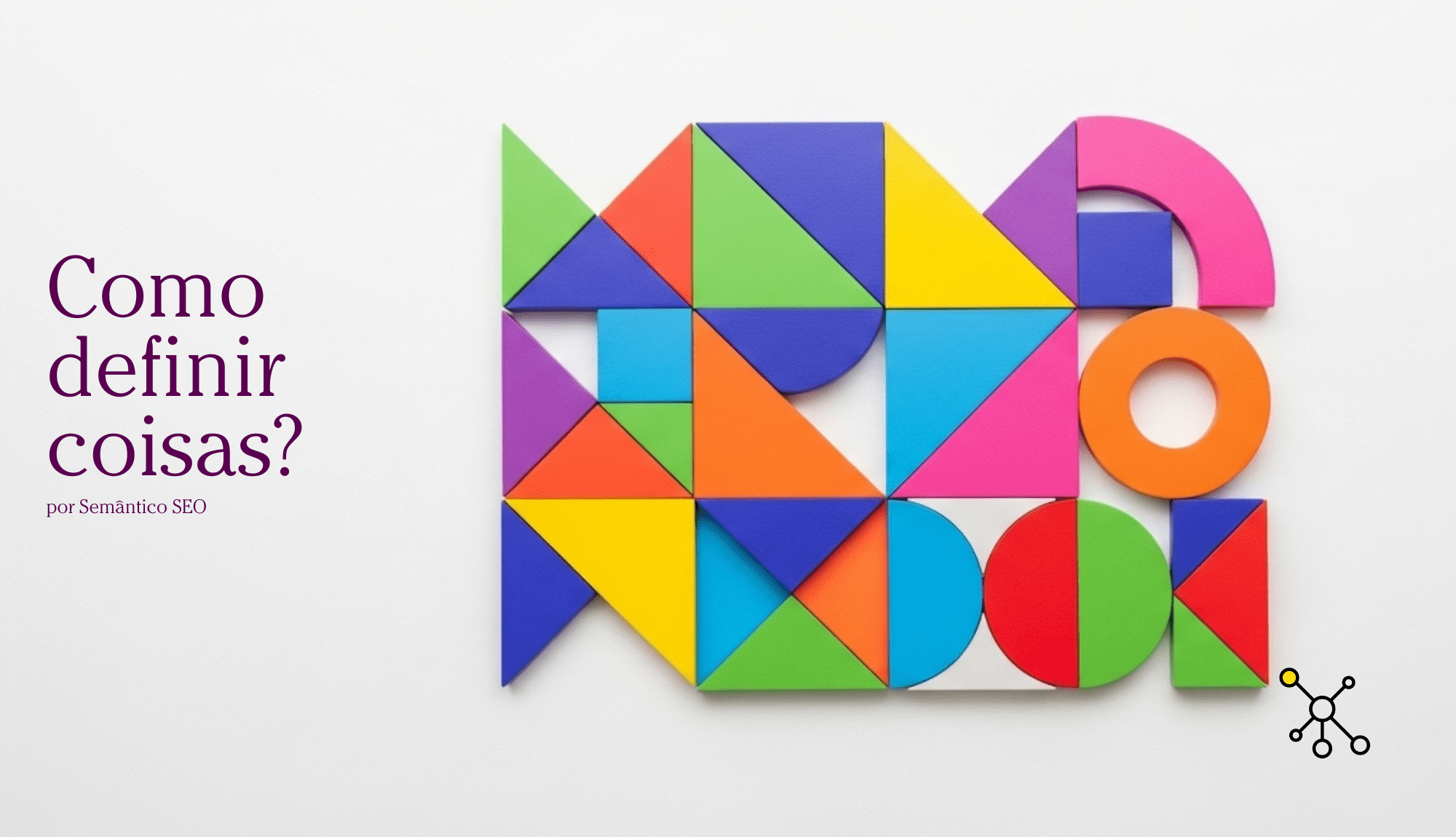
What is the process of defining the things that surround us?
I was listening to a podcast and the interviewer asks the person being interviewed how she defines her profession. I then asked myself the same question: How do I define an SEO? How do I explain this to my mother?
My profession has the problem of having the same word to define what the field is that we work in (Search Engine Optimization) and the professional who works in that field, the SEO (analyst, specialist, etc.).
And then I started thinking about different ways that different professionals define SEO.
For me, SEO is not a set of techniques but a strategic vision that needs to be aligned with the objectives of the business where I work, regardless of the role. Some people do not agree with me, which is completely natural, and because of this they define the same activity in a completely different way from mine.
People who define SEO the same way I do, who see the role of Semantics in our work, call SEO Semantic. Google pushed us in this direction and the way we define our professional activity changed with this movement.
If you want to watch the video below, I discuss further how this different definition changes the way I (and many other professionals) work today differently from the traditional SEO market, but in this text I want to go further.
The problem of defining concepts in information retrieval.
When we talk about entities, the fundamental building blocks of what we call a knowledge graph, generated through the creation of taxonomies and ontologies, we are talking about a problem to be constantly faced: ambiguity.
How do we know which entity we are referring to when I mention, for example, the word Jaguar?
- Jaguar can be an automobile brand.
- Jaguar can be a soccer team.
- Jaguar can be an animal.
Which jaguar are you talking about? Through context, we naturally and almost instantaneously perform disambiguation. This term also has several meanings, depending on the area of knowledge that deals with it; for example, disambiguation in linguistics is linked to the “process of clarifying a message that has more than one meaning. An ambiguous term is, then, one that conveys a confusing message or instruction and that can be interpreted in more than one way.”
On Wikipedia we see that:
Disambiguation is used both in writing and in speech, in sign language, and even in computerized systems—when two objects (or actions, or adjectives, including concrete and abstract terms) have the same name.
Disambiguation in Wikipedia
If you access Wikipedia you have already seen the disambiguation pages. They refer to the same term that can generate more than one possible interpretation (distinct concepts) depending on the contexts, and are created to organize the links and information for the pages with the exact meaning of each one.
Defining and helping to retrieve information
The correct definition of the concepts and entities you use in your content is one of the best ways to ensure that algorithms truly understand what you are writing.
For this I will leave you a tip for a Semantic tool:
Sentence Syntactic Analysis – Semantic SEO
Use the Semantic SEO sentence syntactic analyzer and understand how algorithms and AIs understand the sentences you create!
https://colab.research.google.com/drive/13b6jFMI0SGoqr1hDXhpvg8qEABXpAQKO?usp=sharing
This Notebook was created to help writers understand how algorithms and AI models can understand their sentences. It works by analyzing sentences—do not use paragraphs and complete texts, it will not work—and showing the understanding in the form of graphs. The main functionality is the DEPENDENCY TREE. Analyze how an algorithm analyzes the components of your text and relates them. Change their order and see the impact on understanding.
This post was inspired by a series of short videos I recorded in an attempt to share some questions that came to my mind during my studies in SEO, Semantic Web, ontologies and taxonomies, which today are related to my work and the methodology I created, called Semantic Workflow, and some thoughts on the future of SEO.