

Esse artigo pode ser lido em:


SEO since its inception has been a constant mutant. Today there is a lot of talk about SEO and AEO, with the latter being a natural evolution of the former. Search engine optimization is naturally moving towards voice search optimization.
As companies expand their fields of study(Artificial Intelligence, “Learning Machines”) and new generations take ownership of these new ways of looking for what they want, we professionals have to update, test, and apply them to our projects.
To try to understand this scenario, in this article we will analyze these four points:
- Define What It Is AEO Answer Engine Optimization;
- Let’s talk about the evolution of search engines into a question answering machine;
- Describe the evolution of SEO as a business strategy;
- Pointing out some paths where AEO will take us.
AEO: Answer Engine Optimization
In good Portuguese: Optimization for Response Mechanisms
With the rise of voice search, Google and other companies such as Bing and Amazon are increasingly relying on their voice understanding systems and algorithms that turn audio into searches. Understanding and credibility are key factors when it comes to providing a unique solution for searchers.
The voice is naturally more detailed, more natural … and finally requires a single response.
In this type of search there is only one answer and one chance to please the consumer.
What is AEO?
Answer Engine Optimization is a set of techniques that optimizes a piece of content so that a search engine will use it to answer user questions.
Search engines are becoming machines for answering questions.
The Evolution of SEO in AEO
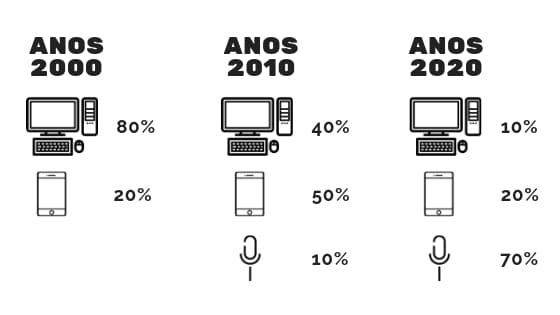
In the 2000s, 80% of searches were done on desktop computers and only 20% on mobile devices. By the 2010s, 50% of searches were already done on smartphones, against 40% on desktops, and voice searches appeared for the first time, with 10%.
The projection for 2020 is that this scenario will change dramatically with 70% of searches being done by voice.
This is why SEO must become AEO.
The evolution of search engines
From search engine to answer engine
Long ago, the History of the Web tells us, information was spread over a semi-connected network of pages. And the search engine was born. And he called himself Google.
Our goal is to organize all the information in the world.
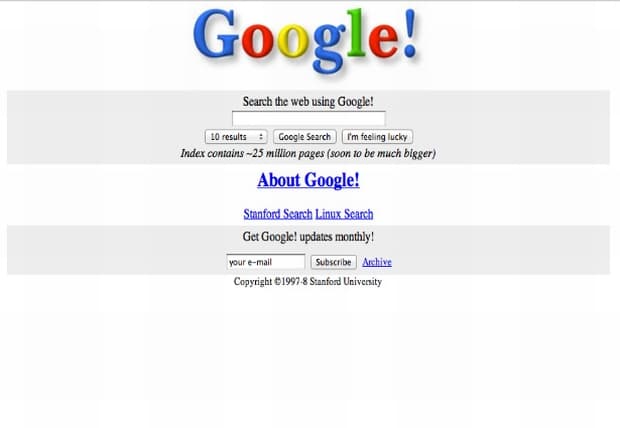
And with it came SEO: a series of crazy strategies that made sites appear in the top positions on that site that, with a small search field, gave us access to “all the content in the world”.
Time has passed, other companies have emerged, most no longer exist. Giants like Amazon and Microsoft also have their search systems, with relative success.
Apple, because of the launch of the iPhone, entered this fight with their system, even though they face problems, they keep evolving.
Today new technologies, mostly developed by Google, have changed the search landscape completely.
These days, to rank higher in Google, you have to pay attention to what people are talking about.
A new business strategy for AEO
A good portion of businesses already understand the importance of SEO. A fraction of them apply the best techniques and succeed over time. If your company is in this select group: Congratulations!
But then I ask you a question: How will you maintain the success of your site, if people don’t even come to it anymore? If people get the answers they need right from a question, answered by Google, right from the search results?
A tip: don’t despair, there are ways to do this. I have prepared two contents:
What Will SEO Look Like in the Future?
e
How to rank in Google in 2019
.
How they will adapt their company to this new scenario.
However, the scenario presents a challenge for the large group of businesses that have not yet been able to leverage SEO, Content Marketing, Inbound, and other Digital Marketing strategies:
How to make the transition straight from interruptive offline marketing to cutting-edge technology-based marketing?
If you understand that you must do this, contact me and I can help you.
Paths to where the AEO will lead us
When a change as radical as this is implemented, we need to take a step back and look at the whole picture.
What possibilities and challenges does voice search optimization present?
The first challenge/opportunity is the entry of new users.
According to data from IBGE’s 2016 Continuous National Household Sample Survey (Pnad C), online Brazilians make up 64.7% of the entire population.
According to this same survey, the age group, individuals between the ages of 18 and 24 had the highest connection rate: 85%.
Brazilians over 60 years old had the lowest rate, at 25%.
The opportunity is clear: we have a huge amount of people who need and want access to online services and products, but who are outside this market.
Google Lens Text to Speech
At Google I/O 2019, during the presentation of Google Lens for Google Go (the search app for simpler devices), the company revealed that the app will be able to read any text aloud and even translate it into the user’s native language.
The application is very light, which allows you to include it on very cheap cell phones.
Google has given a practical example of what this can mean for people who have difficulty reading.
In the example in the video the mother is helped by the search because she cannot read. This is also a reality in our country. But imagine how this same functionality can help those who can no longer see as they used to, or have trouble typing on a device with a screen with small letters and buttons?
Your most loyal customer may be 60 or older and have trouble finding your products. He will love you if you solve this problem with technology.
Now think about your business: what should voice search technology impact it? How will you solve new problems with services and products?
If you want, leave a comment below and I will reply.