


This article aims to propose a new methodology for planning and managing web content optimized for searches as an alternative to the model focused on search intent created by Google. I will critique the search intent model through a brief historical analysis of the company’s documentation, taking the cognitivist paradigm of Information Science as my theoretical basis.
I will describe Kuhlthau’s information search process, its influences, and possible implications for creating content for the Web, based on the book Manual de Estudos de Usuário da Informação by Murilo Bastos da Cunha, Sueli Angelica do Amaral, and Edmundo Brandão Dantas. Finally, I will propose an alternative methodology to the search intent-focused model.
Critique of the search intent model
Currently, the model that seeks to understand why people perform online searches, based on the intent behind each user initiative, is an industry standard for content creation and SEO.
Despite its unequivocal contribution, this model has a problem that has not been explored by professionals in our field: using only a single dimension to understand the information search process (intent) not only limits our understanding but also ignores other aspects of the subjectivity of those searching for information, especially on the web.
But first, let us look to the past and understand how we got here.
Historical analysis
Google began using search intent to try to predict what each search meant, as we can analyze in the Search Quality Evaluator Guidelines documentation.
According to the site Search Engine Journal, there is a science behind the use of intent in information retrieval on the web. The article Utilizing Search Intent in Topic Ontology-based User Profile for Web Mining by Xujuan Zhou, Sheng-Tang Wu, Yuefeng Li, Yue Xu, Raymond Y.K. Lau, and Peter D. Bruza investigates the effectiveness of information retrieval processes. It demonstrates that there is a problem in using generic user profiles in Web Mining systems, proposing the use of search intent to enrich these profiles.
Reading the research Abstract helps us understand this better:
It is common knowledge that taking Web user profiles into consideration can increase the effectiveness of Web mining systems. However, due to the dynamic and complex nature of network users, automatically acquiring (user) profiles that bring value has been very challenging. Ontology-based user profiles can provide more accurate user information. This research emphasizes acquiring search intent information. This article presents a novel approach to developing user profiles for Web search. The model considers the user’s search intents through the PTM (Pattern-Taxonomy Model) process. Initial experiments show that the search intent-based user profile is more valuable than the generic PTM user profile. Developing a user profile that contains the user’s research intents is essential for effective Web search and retrieval. – Translation by the author.
In the document, we saw that search segments search intent into two objectives, at a basic level:
- The initiation stage, when there is recognition of the information need;
- The selection stage begins the work of delimiting the field or research topic;
- The exploration stage of documents about the topic, leading to an expansion of the general topic (for example, reading secondary sources);
- The formulation stage, in which the focus or perspective of the problem is established;
- The collection stage through interaction with information systems and services to gather information;
- And the presentation stage, the “end” of the search and “solution” of the problem.
- Initiation;
- Exploration;
- Collection.
- visceral,
- conscious,
- formalized,
- compromised.
- stated needs (the customer wants a cheap TV);
- real needs (the customer wants a TV that lasts a long time, but doesn’t care about the price);
- unstated needs (the customer expects good service from the salesperson);
- delight needs (the customer would like the salesperson to include a sound system as a free gift);
- secret needs (the customer wants to be seen by friends as a savvy consumer).
In the presentation, Illyes and Haahr provide an engineer’s perspective on how Google classifies information, makes algorithm changes, and how this process determines information retrieval in the SERP, showing how challenging it is to provide the most relevant results to users.
In this presentation, we hear about the famous 200+ ranking signals that determine the order in search results and how search algorithms are constantly evolving.
We also hear about minor algorithmic tweaks made almost daily and core updates that can profoundly alter the SERP.
Although the presentation is old, I recommend watching it because it covers the basic process of a retrieval tool along with our search engines: crawling, document analysis, ranking, and retrieval. This does not change and will not change.
(I know you are thinking: what about Google Bard? Well, it is not an information retrieval tool; it generates information)
This, in short, was the approach of the study that inspired Google, so to speak, to expand this model and create the four search intents.
Description of Google documentation
As is common knowledge, Google uses human reviewers to perform quality control on the information it retrieves. And these evaluators have extensive documentation they must follow to ensure the quality of their work.
I do not intend to describe all the processes detailed in the documentation (which every SEO professional should read). For the purpose of this article, we will focus on the process that uses user search intent.
The excerpt I want to highlight begins by analyzing the meaning they gave to the term “multiple meanings of a search”, with a visual example reproduced below:
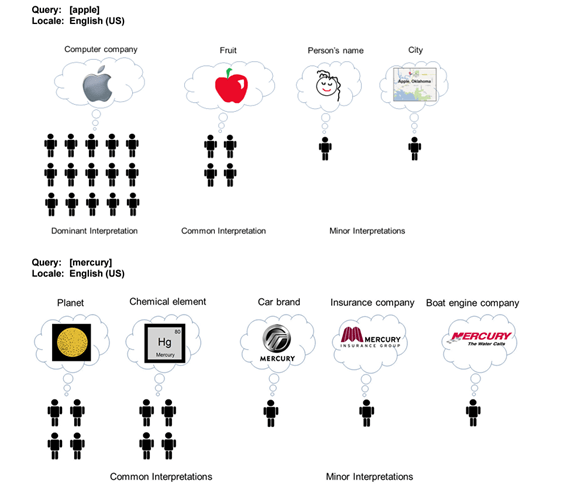
Queries with Multiple Meanings
Many queries have more than one meaning. For example, the query [apple] might refer to the computer brand or the fruit. We will call these possible meanings query interpretations. Dominant Interpretation: The dominant interpretation of a query is what most users mean when they type the query. Not all queries have a dominant interpretation. The dominant interpretation should be clear to you, especially after doing a little web research. Common Interpretation: A common interpretation of a query is what many or some users mean when they type a query. A query can have multiple common interpretations. Minor Interpretations: Sometimes you will find less common interpretations. These are interpretations that few users have in mind. We will call these minor interpretations.
They divide queries regarding meanings into four segments:
- Critique of the model
As I briefly discussed earlier in this text, I understand that the search intent model was important for its pioneering nature, but it has weaknesses that can be resolved by using more robust models.
I need to raise a point that, in my view, greatly helps us understand the process of searching for information.
The beginning of this process is triggered by what Brenda Dervin called, in 1983, a cognitive void, which occurs when we are in a situation where the answers we have to our questions are no longer sufficient to bridge this gap between what we know and what we need to know.
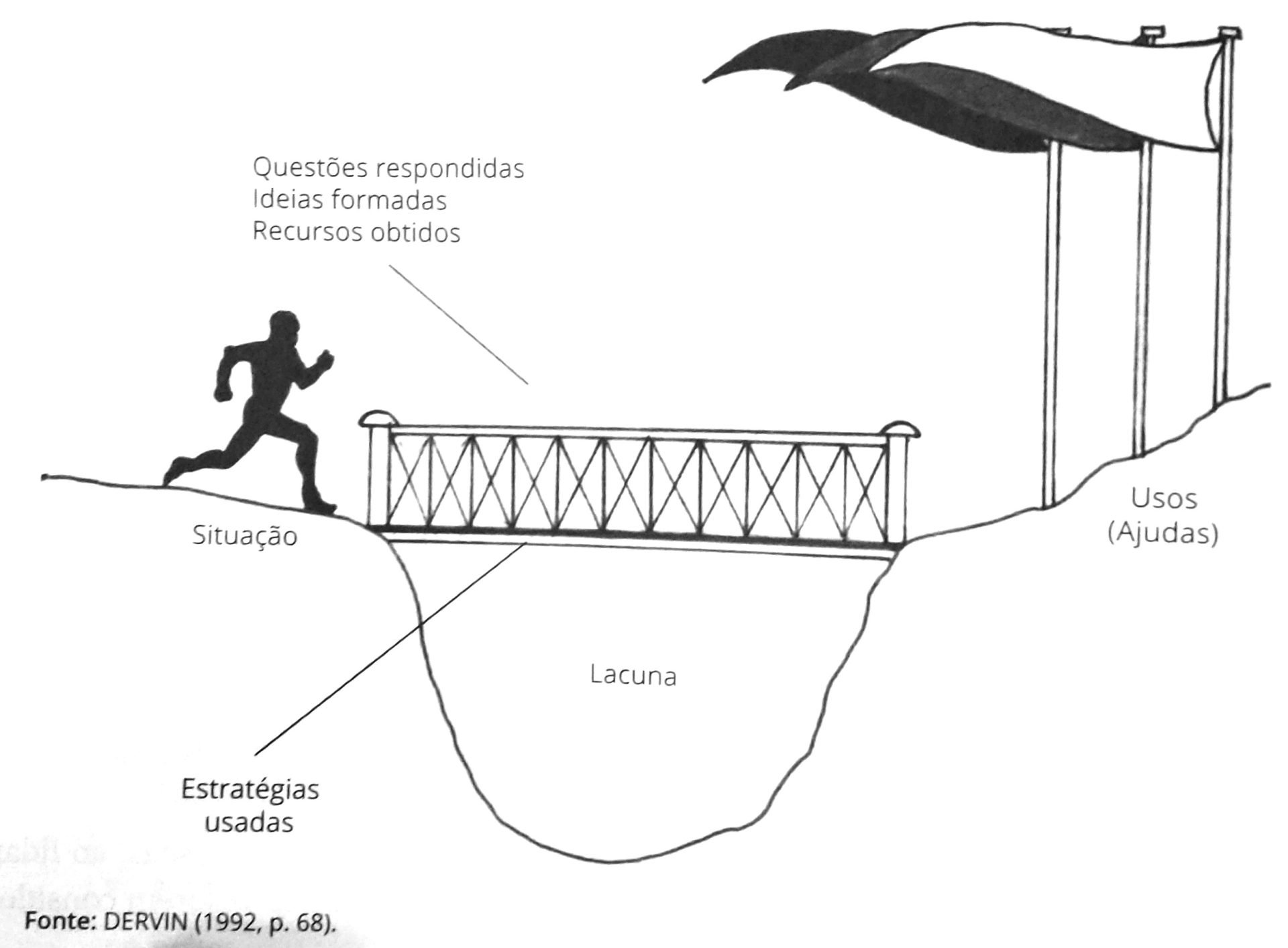
Extracted from the book Manual de Estudos de Usuário da Informação
This feeling of uncertainty leads us to wander in search of information that already exists, but is not part of our set of known information.
Understanding search intents does not take into account this void or the feelings triggered by it.
Therefore, this article proposes an alternative to this model, based on the work of American researcher and educator Carol Kuhlthau, recognizing the importance of identifying the information needs of various user segments.
Identifying user information needs is the vital point of my proposal, and we agree with Cunha (2015) when he states that this is a vital step toward understanding strategic objectives and is paramount in defining the collection development policy and determining whether demands are met (emphasis mine).
In our work environment, we need to understand that the collection comprises all types of content created and made available for users (current, potential, and non-users) to access.
Therefore, once again bringing Information Science studies into our work environment: we need to understand the information needs of those searching for what we are offering on the web, since the content we publish on this network constitutes our collection, which requires more appropriate policies for its development.
This article does not cover this broad subject, but makes use of the model created by Kuhlthau to initiate this process.
Who is Carol Kuhlthau?
Carol Collier Kuhlthau (born December 2, 1937) is a retired American educator, researcher, and international speaker on school library learning, information literacy, and information-seeking behavior.
Biography
Kuhlthau was born in New Brunswick, New Jersey, USA. Kuhlthau graduated from Kean University in 1959. She completed a master’s degree in Library Science at Rutgers University in 1974 and a doctorate in Education in 1983. She was a professor in the Department of Library and Information Science at Rutgers University for over 20 years and has been professor emerita since 2006.
Carol Kuhlthau founded the Center for International Scholarship in School Libraries.
Kuhlthau’s information search process
In theoretical terms, this article and the proposals we make within it are tied to the cognitivist paradigm, in which Ellis, Dervin, Kuhlthau, and Wilson are the researchers chosen as a foundation.
We warn that care must be taken not to innovate in theory while repeating previous models in application, as Carlos Alberto Ávila Araújo points out in his text Estudos de usuários: pluralidade teórica, diversidade de objetos on page 8:
The cognitive model of these studies, by prioritizing the understanding of the information need based on a gap, on an absence of a certain knowledge to execute a certain activity, ends up restricting the way users are understood as beings endowed with a specific need that would be satisfied by a specific information source.
Therefore, this article, besides contrasting the model of creating web content based on search intent with our proposal, proposes a new model for content creation, which needs to be tested and validated in practice.
Influence of Jean Piaget and Brenda Dervin on Kuhlthau
In 1991, Kuhlthau’s model was introduced under the name Information Search Process (ISP). It describes how feelings, thoughts, and actions are present in six stages of information seeking.
The ISP model is based on Jean Piaget’s work, that is, on the four stages of cognitive development in children, namely: sensorimotor, preoperational, concrete operational, and formal operational.
Kuhlthau introduced the holistic information-seeking experience through the individual’s perspective, emphasizing the vital role of affect in information seeking and proposing the uncertainty principle as a conceptual framework for libraries and information services.
I understand that a search engine falls into the category of information services.
Kuhlthau’s work is among the most cited by professors of library and information science and is one of the most used conceptualizations by researchers in the field.
The ISP model represents a turning point in the development of new strategies for understanding how people search for information.
Information Search Process (ISP)
Also within the scope of the alternative approach, Carol Kuhlthau (1991) defended the Constructive Process Approach to conduct user studies and developed the Information Search Process (ISP) model, represented in the Figure below, extracted from the book Manual de Estudos de Usuário da Informação.
Figure 5.8 – Information search process
| ISP stages | Feelings at each stage | Thoughts at each stage | Actions at each stage | Appropriate tasks |
|---|---|---|---|---|
| 1. Initiatione-column-delimiter/>Uncertainty | General/Vague | Search for pre-existing information | Recognition | |
| 2. Selection | Optimism | Identification | ||
| 3. Exploration | Confusion/frustration/Doubt | Search for relevant information | Investigation | |
| 4. Formulation | Clarity | Directed/Clear | Formulation | |
| 5. Collection | Sense of direction/Confidence | Increased interest | Focused or relevant information search | Connection |
| 6. Presentation | Relief/Satisfaction or Disappointment | Clear or focused | Complementation |
For the authors, during the information search process (uncertainty principle), Kuhlthau considers that the level of uncertainty is fluctuating and can be observed in six stages, divided into three fields of experience: emotional, cognitive, and physical:
According to González-Teruel (2005, p. 72), Kuhlthau’s information search process model identifies the information need with the state of uncertainty that commonly causes anxiety and a lack of confidence. For the researcher, uncertainty is a natural state, especially in the early stages of the information search process.
Rolim and Cendón (2013) argue that the stages can be visualized from the dynamic character of the information search process, because in this process there is construction of knowledge and meaning. The formulation of a focus of interest affects the search process, because to establish the focus it is necessary to interpret existing information. The nature of the information found alters the user’s position, because if the information is redundant it can cause boredom, but new information may require a reconfiguration of unavailable knowledge, causing anxiety. The user’s attitude influences the search result, because their search implies personal choices and interest increases as the focus is defined and research advances.
It is interesting to notice in this excerpt the reciprocity between our needs and what we manage to find when we carry out a search for some information to satisfy these needs. Feelings such as anxiety, frustration, boredom, enthusiasm, euphoria, and joy are not normally taken into account when we study the searches of our visitors, but they are part of every searching individual.
Proposal for a new methodology for planning content optimized for searches
Based on this approach, we describe and propose a new content creation model based on Kuhlthau’s (1991) research, which I describe in more detail below. First, I want to provide some details to make certain points explicit, especially because the model I describe is an adaptation of Kuhlthau’s work.
Adaptation of the information search process
In the table below, in green, are the stages selected by me for the adaptation of the ISP to create content optimized for searches.
| ISP stages | Feelings at each stage | Thoughts at each stage | Actions at each stage | Appropriate tasks |
|---|---|---|---|---|
| Initiation | Uncertainty | General/Vague | Search for pre-existing information | Recognition |
| Selection | Optimism | Identification | ||
| Exploration | Confusion/frustration/Doubt | Search for relevant information | Investigation | |
| Formulation | Clarity | Directed/Clear | Formulation | |
| Collection | Sense of direction/Confidence | Increased interest | Search for focused or relevant information | Connection |
| Presentation | Relief/Satisfaction or Disappointment | Clear or focused | Complementation |
The intention is to propose a new way of planning the creation of content based on three stages of the process from the table “Information search process” proposed by Kuhlthau:
All six phases are present in any information search process, but in my view, the phases I selected are perfectly aligned with web content management.
I understand that this model allows for the creation of a structure that aligns creation with the needs of our users, aligning them with a management and creation process that helps satisfy these informational needs at each stage of the search.
Our proposal aims to consider the importance of needs, desires, demands, expectations, attitudes, behaviors, and other practices in the use of information by users who look for information that creators can provide in their content.
However, in counterpoint, we cite Hewins (1990) apud Cunha (2015) to emphasize that
there are unique characteristics for each user and others that are common to several, which is why systems must be developed considering the flexibility necessary to be adaptable to all users.
Of course, Hewins was dealing with information retrieval systems, but we can broaden this sense and say that for our proposal to be minimally effective, we need to develop a model that can be adapted to both cases: specific publics and a general audience.
Taylor in 1968, speaking about the questions library users asked, established an interesting relationship between the questions asked and the actual needs of users.
This work generated a classification of information needs that is interesting for our work:
Visceral need
It can be related to a vague dissatisfaction, but this feeling is not strong enough to generate a question. However, this state can change if the person has access to some information that changes this feeling and encourages them to ask the question.
Conscious need
There is a mental confusion that in some way influences the formulation of the question.
Formalized need
When the individual manages to resolve this confusion to a certain degree, they formulate the question that triggers the information search process.
Compromised need
This is the question that has been modified or reworked so that it can be understood by an information system that cannot handle, for example, natural language search. Here the user needs to adapt to the system and not the other way around.
When Kotler (2000, p. 43) addresses the subject from a marketing standpoint, he warns that these five types of needs exist:
With this in mind, we created the model below, which aims to serve as a foundation for generating models for content management and creation that take into account the phases already described by us: initiation, exploration, and information collection.
I would like to remind you that the most important thing is not the model—which can and should be constantly adapted, updated, and improved—but rather a new mindset regarding how we create content on the web.
A new type of paradigm motivated by the needs of the people who require the services and products your company wants to deliver to them.
I want to recall our theoretical basis for the creation of the model below, using this table:
| Stages in ISP | Feelings at each stage | Thoughts at each stage | Actions at each stage | Appropriate tasks |
|---|---|---|---|---|
| Initiation | Uncertainty | General/Vague | Search for pre-existing information | Recognition |
| Exploration | Confusion/frustration/Doubt | Search for relevant information | Investigation | |
| Collection | Sense of direction/Confidence | Increased interest | Search for focused or relevant information | Connection |
Briefing creation model
Create content {FEELING RESOLUTION} that generates {APPROPRIATE TASKS} about {ACTIONS} aiming to reduce {FEELINGS} that visitors who are in the {STAGE} stage feel.
Example:
Create content, specific and precise, that generates recognition of pre-existing information aiming to reduce the uncertainty felt by visitors who are in the initiation stage.
The model below should be used when generating content briefs with the objective of creating aligned with users’ feelings, the stage they are in, and how your content should be generated to fulfill these needs.
Concluding. For now.
To conclude this first version of my proposal that connects SEO, content management, and the ISP Model, I want to say that those of us who work with and on the web have a lot to learn from Library Science and Information Science.
There is a vast body of knowledge generated over centuries of study in this field that is closely linked to our daily practice. Understanding this connection is what led me, at nearly 50 years old, to enter university again and take another degree.
This has been my mission since the day I attended my first class: to connect these two worlds.
{“translated_html”: “dbpedia.org/resource/Sistema_sensorial\”,\”http://fi.dbpedia.org/resource/Aistinelin\”,\”http://fr.dbpedia.org/resource/Système_sensoriel\”,\”http://hr.dbpedia.org/resource/Osjetilni_sustav\”,\”http://hu.dbpedia.org/resource/Érzékszerv\”,\”http://id.dbpedia.org/resource/Sistem_indera\”,\”http://is.dbpedia.org/resource/Athygli\”,\”http://it.dbpedia.org/resource/Organi_di_senso\”,\”http://lt.dbpedia.org/resource/Jutimo_organai\”,\”http://lv.dbpedia.org/resource/Maņu_orgānu_sistēma\”,\”http://nl.dbpedia.org/resource/Zintuigstelsel\”,\”http://no.dbpedia.org/resource/Sansesystem\”,\”http://pl.dbpedia.org/resource/Narządy_zmysłów\”,\”http://pt.dbpedia.org/resource/Sistema_sensorial\”,\”http://ro.dbpedia.org/resource/Sistem_senzorial\”,\”http://ru.dbpedia.org/resource/Сенсорная_система\”,\”http://sk.dbpedia.org/resource/Telesný_zmysel\”,\”http://sl.dbpedia.org/resource/Čutilo\”,\”http://sr.dbpedia.org/resource/Чулни_орган\”,\”http://sv.dbpedia.org/resource/Sinnesorgan\”,\”http://tr.dbpedia.org/resource/Duyu_sistemi\”,\”http://uk.dbpedia.org/resource/Сенсорна_система\”],\”types\”:[\”thing\”]}”} {“translated_html”: “\nNew proposal for web content management focusing on information science and semantic workflow.
\n”} .org/resource/Оптимизация_(математика)”,”http://sk.dbpedia.org/resource/Optimalizácia_(matematika)”,”http://sl.dbpedia.org/resource/Optimizacija_(matematika)”,”http://sr.dbpedia.org/resource/Оптимизација_(математика)”,”http://sv.dbpedia.org/resource/Optimeringslära”,”http://tr.dbpedia.org/resource/Optimizasyon”,”http://uk.dbpedia.org/resource/Оптимізація_(математика)”],”types”:[“creative-work”]},”annotations”:{“urn:enhancement-e9d989a0-a268-46bf-9f2a-383965542c61”:{“start”:1110,”end”:1116,”text”:”padrão”}},”id”:”http://data.wordlift.io/wl01797/entity/padroes”,”label”:”Patterns”,”mainType”:”thing”,”occurrences”:[“urn:enhancement-e9d989a0-a268-46bf-9f2a-383965542c61″],”sameAs”:[“http://dbpedia.org/resource/Pattern”,”http://de.dbpedia.org/resource/Muster_(Struktur)”,”http://en.dbpedia.org/resource/Pattern”,”http://es.dbpedia.org/resource/Patrón_(estructura)”,”http://id.dbpedia.org/resource/Pola”,”http://nl.dbpedia.org/resource/Patroon_(vorm)”,”http://no.dbpedia.org/resource/Mønster”,”http://pt.dbpedia.org/resource/Padrão”,”http://ru.dbpedia.org/resource/Паттерн”,”http://tr.dbpedia.org/resource/Örüntü”,”http://uk.dbpedia.org/resource/Патерн”],”types”:[“thing”]},”annotations”:{“urn:enhancement-841e6bec-3ba6-4f9e-8e50-82c93e0ee0c0”:{“start”:4298,”end”:4317,”text”:”mecanismos de busca”},”urn:enhancement-38b2677d-b480-43ac-bf44-4b66c52fcb90″:{“start”:9990,”end”:9998,”text”:”buscador”},”urn:enhancement-1c4ec2cb-236c-4ca6-b0e6-1076d4832074″:{“start”:16088,”end”:16096,”text”:”buscador”}},”id”:”http://data.wordlift.io/wl01797/entity/motor_de_busca”,”label”:”Search engine”,”mainType”:”thing”,”occurrences”:[“urn:enhancement-841e6bec-3ba6-4f9e-8e50-82c93e0ee0c0″,”urn:enhancement-38b2677d-b480-43ac-bf44-4b66c52fcb90″,”urn:enhancement-1c4ec2cb-236c-4ca6-b0e6-1076d4832074″],”sameAs”:[“http://be.dbpedia.org/resource/Пошукавая_сістэма”,”http://bg.dbpedia.org/resource/Търсачка”,”http://ca.dbpedia.org/resource/Motor_de_cerca”,”http://cs.dbpedia.org/resource/Vyhledávač”,”http://da.dbpedia.org/resource/Søgemaskine”,”http://dbpedia.org/resource/Search_engine_(computing)”,”http://de.dbpedia.org/resource/Suchmaschine”,”http://en.dbpedia.org/resource/Search_engine_(computing)”,”http://es.dbpedia.org/resource/Motor_de_búsqueda”,”http://et.dbpedia.org/resource/Otsingumootor”,”http://fi.dbpedia.org/resource/Hakukone”,”http://hr.dbpedia.org/resource/Tražilica”,”http://hu.dbpedia.org/resource/Keresőmotor”,”http://it.dbpedia.org/resource/Motore_di_ricerca”,”http://lv.dbpedia.org/resource/Meklētājprogramma”,”http://nl.dbpedia.org/resource/Zoekmachine”,”http://no.dbpedia.org/resource/Søkemotor”,”http://pl.dbpedia.org/resource/Wyszukiwarka_internetowa”,”http://pt.dbpedia.org/resource/Motor_de_busca”,”http://rdf.freebase.com/ns/m.06xw2″,”http://ro.dbpedia.org/resource/Motor_de_căutare”,”http://ru.dbpedia.org/resource/Поисковая_машина”,”http://sk.dbpedia.org/resource/Search_engine”,”http://sl.dbpedia.org/resource/Spletni_iskalnik”,”http://sv.dbpedia.org/resource/Söktjänst”,”http://tr.dbpedia.org/resource/Arama_motoru”,”http://uk.dbpedia.org/resource/Пошукова_система”,”http://yago-knowledge.org/resource/Search_engine_(computing)”],”types”:[“thing”]},”annotations”:{“urn:enhancement-a8aa26a2-cd5d-44e1-a0cc-de6eb36b215c”:{“start”:20340,”end”:20352,”text”:”conhecimento”},”urn:enhancement-c0213c1b-800b-4d0d-960b-2d2a3b88108a”:{“start”:30327,”end”:30340,”text”:”conhecimentos”},”urn:enhancement-44ae668a-c45f-42c7-a80f-d15f3c92f510″:{“start”:20696,”end”:20709,”text”:”conhecimentos”},”urn:enhancement-a46a5329-e0cf-4b18-bcdd-81eede464be4″:{“start”:2554,”end”:2566,”text”:”conhecimento”},”urn:enhancement-72bb5a67-163a-432f-a226-466d17322a8d”:{“start”:14942,”end”:14954,”text”:”conhecimento”},”urn:enhancement-67bca80c-9b16-49b1-931f-ccee1070da7b”:{“start”:7619,”end”:7631,”text”:”conhecimento”}},”id”:”http://data.wordlift.io/wl01797/entity/conhecimento”,”label”:”Knowledge”,”mainType”:”thing”,”occurrences”:[“urn:enhancement-a46a5329-e0cf-4b18-bcdd-81eede464be4″,”urn:enhancement-67bca80c-9b16-49b1-931f-ccee1070da7b”,”urn:enhancement-72bb5a67-163a-432f-a226-466d17322a8d”,”urn:enhancement-a8aa26a2-cd5d-44e1-a0cc-de6eb36b215c”,”urn:enhancement-44ae668a-c45f-42c7-a80f-d15f3c92f510″,”urn:enhancement-c0213c1b-800b-4d0d-960b-2d2a3b88108a”],”sameAs”:[“http://be.dbpedia.org/resource/Веды”,”http://bg.dbpedia.org/resource/Знание”,”http://ca.dbpedia.org/resource/Coneixement”,”http://cs.dbpedia.org/resource/Poznatek”,”http://da.dbpedia.org/resource/Viden”,”http://dbpedia.org/resource/Knowledge”,”http://de.dbpedia.org/resource/Wissen”,”http://en.dbpedia.org/resource/Knowledge”,”http://es.dbpedia.org/resource/Conocimiento”,”http://et.dbpedia.org/resource/Teadmine”,”http://fi.dbpedia.org/resource/Tieto”,”http://fr.dbpedia.org/resource/Connaissance”,”http://hr.dbpedia.org/resource/Znanje”,”http://hu.dbpedia.org/resource/Ismeret”,”http://id.dbpedia.org/resource/Pengetahuan”,”http://is.dbpedia.org/resource/Þekking”,”http://it.dbpedia.org/resource/Conoscenza”,”http://lt.dbpedia.org/resource/Žinios”,”http://lv.dbpedia.org/resource/Zināšanas”,”http://nl.dbpedia.org/resource/Kennis”,”http://no.dbpedia.org/resource/Kunnskap”,”http://pl.dbpedia.org/resource/Wiedza”,”http://pt.dbpedia.org/resource/Conhecimento”,”http://rdf.freebase.com/ns/m.01k8wb”,”http://ro.dbpedia.org/resource/Cunoaștere”,”http://ru.dbpedia.org/resource/Знание”,”http://sk.dbpedia.org/resource/Vedenie_(filozofia)”,”http://sl.dbpedia.org/resource/Znanje”,”http://sq.dbpedia.org/resource/Dituria”,”http://sr.dbpedia.org/resource/Знање”,”http://sv.dbpedia.org/resource/Kunskap”,”http://tr.dbpedia.org/resource/Bilgi”,”http://uk.dbpedia.org/resource/Знання”],”types”:[“thing”]},”annotations”:{“urn:enhancement-a632528a-94c8-498a-85fc-8b4f76573784”:{“start”:27593,”end”:27601,”text”:”produtos”}},”id”:”http://data.wordlift.io/wl01797/entity/produto_marketing”,”label”:”Product (marketing)”,”mainType”:”thing”,”occurrences”:[“urn:enhancement-a632528a-94c8-498a-85fc-8b4f76573784″],”sameAs”:[“http://be.dbpedia. org/resource/Прадукт,_бізнес”,”http://bg.dbpedia.org/resource/Продукт”,”http://ca.dbpedia.org/resource/Producte_(màrqueting)”,”http://cs.dbpedia.org/resource/Produkt_(obchod)”,”http://da.dbpedia.org/resource/Produkt_(erhverv)”,”http://dbpedia.org/resource/Product_(business)”,”http://de.dbpedia.org/resource/Produkt_(Wirtschaft)”,”http://en.dbpedia.org/resource/Product_(business)”,”http://es.dbpedia.org/resource/Producto_(marketing)”,”http://et.dbpedia.org/resource/Toode”,”http://fi.dbpedia.org/resource/Tuote”,”http://fr.dbpedia.org/resource/Politique_de_produit”,”http://hr.dbpedia.org/resource/Proizvod”,”http://it.dbpedia.org/resource/Prodotto_(economia)”,”http://lt.dbpedia.org/resource/Gaminys”,”http://nl.dbpedia.org/resource/Product_(economie)”,”http://no.dbpedia.org/resource/Produkt_(økonomi)”,”http://pl.dbpedia.org/resource/Produkt_(marketing)”,”http://pt.dbpedia.org/resource/Produto_(marketing)”,”http://rdf.freebase.com/ns/m.01jwgf”,”http://ru.dbpedia.org/resource/Продукт_(бизнес)”,”http://sk.dbpedia.org/resource/Výrobok”,”http://sr.dbpedia.org/resource/Производ”,”http://sv.dbpedia.org/resource/Produkt_(ekonomi)”,”http://uk.dbpedia.org/resource/Продукт_(економіка)”],”types”:[“thing”]}{“annotations”:{“urn:enhancement-8e0931a4-7639-4f2d-b950-5457c694b341”:{“start”:1144,”end”:1152,”text”:”conteúdo”},”urn:enhancement-cff3b44a-4c2e-44fa-b086-21250c8df32d”:{“start”:24773,”end”:24781,”text”:”conteúdo”},”urn:enhancement-aa72d4c8-9d78-4dac-a141-46c8a1896d7a”:{“start”:27184,”end”:27192,”text”:”conteúdo”},”urn:enhancement-93dffeb1-b440-4d59-bfc5-8a77988161c4″:{“start”:29585,”end”:29593,”text”:”conteúdo”},”urn:enhancement-b2e3a795-c058-4234-a8b3-50fc017f12f7″:{“start”:27472,”end”:27480,”text”:”conteúdo”},”urn:enhancement-b093eba6-0dba-48a8-821f-a655c53a380d”:{“start”:24492,”end”:24500,”text”:”conteúdo”},”urn:enhancement-8e7baa1d-9b2c-4b89-a140-ce903dac7c53″:{“start”:15223,”end”:15231,”text”:”conteúdo”},”urn:enhancement-085b8e9d-d3e6-4b5e-8d6b-44c746ab8dda”:{“start”:717,”end”:725,”text”:”conteúdo”},”urn:enhancement-359a335c-f1f0-4b1d-9bb6-b4c78df2c307″:{“start”:21430,”end”:21438,”text”:”conteúdo”},”urn:enhancement-cf155592-ee43-46da-856c-3dc2473ab515″:{“start”:11246,”end”:11254,”text”:”conteúdo”},”urn:enhancement-4e20f9d5-4148-483e-b0bd-2f84e6b1486f”:{“start”:29892,”end”:29900,”text”:”conteúdo”},”urn:enhancement-daf46002-3175-4806-bce1-c5324b6a68a9″:{“start”:30007,”end”:30015,”text”:”conteúdo”},”urn:enhancement-e29450fd-bf44-4e16-a409-795396c5322f”:{“start”:29406,”end”:29414,”text”:”conteúdo”},”urn:enhancement-9f0a25c3-1c60-42d6-9fd6-a0e6496f1d60″:{“start”:13065,”end”:13073,”text”:”conteúdo”},”urn:enhancement-8924e953-8ff6-4937-b0aa-f3bf2c0ba554″:{“start”:15327,”end”:15335,”text”:”conteúdo”}},”id”:”http://data.wordlift.io/wl01797/entity/conteudo”,”label”:”Conteúdo”,”mainType”:”thing”,”occurrences”:[“urn:enhancement-085b8e9d-d3e6-4b5e-8d6b-44c746ab8dda”,”urn:enhancement-8e0931a4-7639-4f2d-b950-5457c694b341″,”urn:enhancement-cf155592-ee43-46da-856c-3dc2473ab515″,”urn:enhancement-9f0a25c3-1c60-42d6-9fd6-a0e6496f1d60″,”urn:enhancement-8e7baa1d-9b2c-4b89-a140-ce903dac7c53″,”urn:enhancement-8924e953-8ff6-4937-b0aa-f3bf2c0ba554″,”urn:enhancement-359a335c-f1f0-4b1d-9bb6-b4c78df2c307″,”urn:enhancement-b093eba6-0dba-48a8-821f-a655c53a380d”,”urn:enhancement-cff3b44a-4c2e-44fa-b086-21250c8df32d”,”urn:enhancement-aa72d4c8-9d78-4dac-a141-46c8a1896d7a”,”urn:enhancement-b2e3a795-c058-4234-a8b3-50fc017f12f7″,”urn:enhancement-e29450fd-bf44-4e16-a409-795396c5322f”,”urn:enhancement-93dffeb1-b440-4d59-bfc5-8a77988161c4″,”urn:enhancement-4e20f9d5-4148-483e-b0bd-2f84e6b1486f”,”urn:enhancement-daf46002-3175-4806-bce1-c5324b6a68a9″],”sameAs”:[],”types”:[“thing”]}{“annotations”:{“urn:enhancement-d3c7b2fe-f5f4-4827-bf7b-15ec99679c23”:{“start”:2120,”end”:2128,”text”:”Ontology”}},”id”:”http://data.wordlift.io/wl01797/entity/ontologia”,”label”:”Ontologia”,”mainType”:”creative-work”,”occurrences”:[“urn:enhancement-d3c7b2fe-f5f4-4827-bf7b-15ec99679c23″],”sameAs”:[],”types”:[“creative-work”]}{“annotations”:{“urn:enhancement-6ebf1722-12e3-41b0-8995-b3ffa8876e9c”:{“start”:1258,”end”:1271,”text”:”profissionais”}},”id”:”http://data.wordlift.io/wl01797/entity/trabalhador”,”label”:”Trabalhador”,”mainType”:”thing”,”occurrences”:[“urn:enhancement-6ebf1722-12e3-41b0-8995-b3ffa8876e9c”],”sameAs”:[“http://es.dbpedia.org/resource/Trabajador”,”http://fr.dbpedia.org/resource/Ouvrier”,”http://hr.dbpedia.org/resource/Djelatnik”,”http://it.dbpedia.org/resource/Operaio”,”http://nl.dbpedia.org/resource/Arbeider”,”http://pl.dbpedia.org/resource/Robotnik”,”http://pt.dbpedia.org/resource/Trabalhador”,”http://sk.dbpedia.org/resource/Robotník”,”http://sl.dbpedia.org/resource/Delavec”,”http://sv.dbpedia.org/resource/Arbetare”,”http://tr.dbpedia.org/resource/İşçi”,”http://uk.dbpedia.org/resource/Робітник”],”types”:[“thing”]}{“annotations”:{“urn:enhancement-f8794a95-5579-417f-9f81-469510352bf9”:{“start”:19763,”end”:19774,”text”:”experiência”},”urn:enhancement-9122a575-a57d-4d66-9f2f-f7456a4ebf70″:{“start”:15820,”end”:15831,”text”:”experiência”}},”id”:”http://data.wordlift.io/wl01797/entity/experiencia_2″,”label”:”Experiência”,”mainType”:”thing”,”occurrences”:[“urn:enhancement-9122a575-a57d-4d66-9f2f-f7456a4ebf70″,”urn:enhancement-f8794a95-5579-417f-9f81-469510352bf9″],”sameAs”:[“http://ca.dbpedia.org/resource/Experiència”,”http://cs.dbpedia.org/resource/Zkušenost”,”http://da.dbpedia.org/resource/Erfaring”,”http://dbpedia.org/resource/Experience”,”http://de.dbpedia.org/resource/Erfahrung”,”http://en.dbpedia.org/resource/Experience”,”http://es.dbpedia.org/resource/Experiencia”,”http://et.dbpedia.org/resource/Kogemus”,”http://fi.dbpedia.org/resource/Kokemus”,”http://fr.dbpedia.org/resource/Expérience”,”http://hr.dbpedia.org/resource/Iskustvo”,”http://id.dbpedia.org/resource/Pengalaman”,”http://is.dbpedia.org/resource/Reynsla”,”http://it.dbpedia.org/resource/Esperienza”,”http://nl.dbpedia.org/resource/Ervaring”,”http://no.dbpedia.org/resource/Erfaring”,”h ttp://pl.dbpedia.org/resource/Doświadczenie”,”http://pt.dbpedia.org/resource/Experiência_(filosofia)”,”http://ro.dbpedia.org/resource/Experiență”,”http://ru.dbpedia.org/resource/Опытное_знание”,”http://sk.dbpedia.org/resource/Skúsenosť”,”http://sr.dbpedia.org/resource/Iskustvo”,”http://sv.dbpedia.org/resource/Erfarenhet”,”http://tr.dbpedia.org/resource/Tecrübe”,”http://uk.dbpedia.org/resource/Досвід”],”types”:[“thing”]}]} /–>