Abstract: in this article I present the methodology for creating definitions widely used in Library Science for website optimization work in a semantic way, Semântico SEO, as an important aid in solving one of the biggest problems of web search tools: ambiguity.
The main problem that automated information retrieval systems (web search engines fall into this category) face is having a high degree of certainty about the information the user wants.
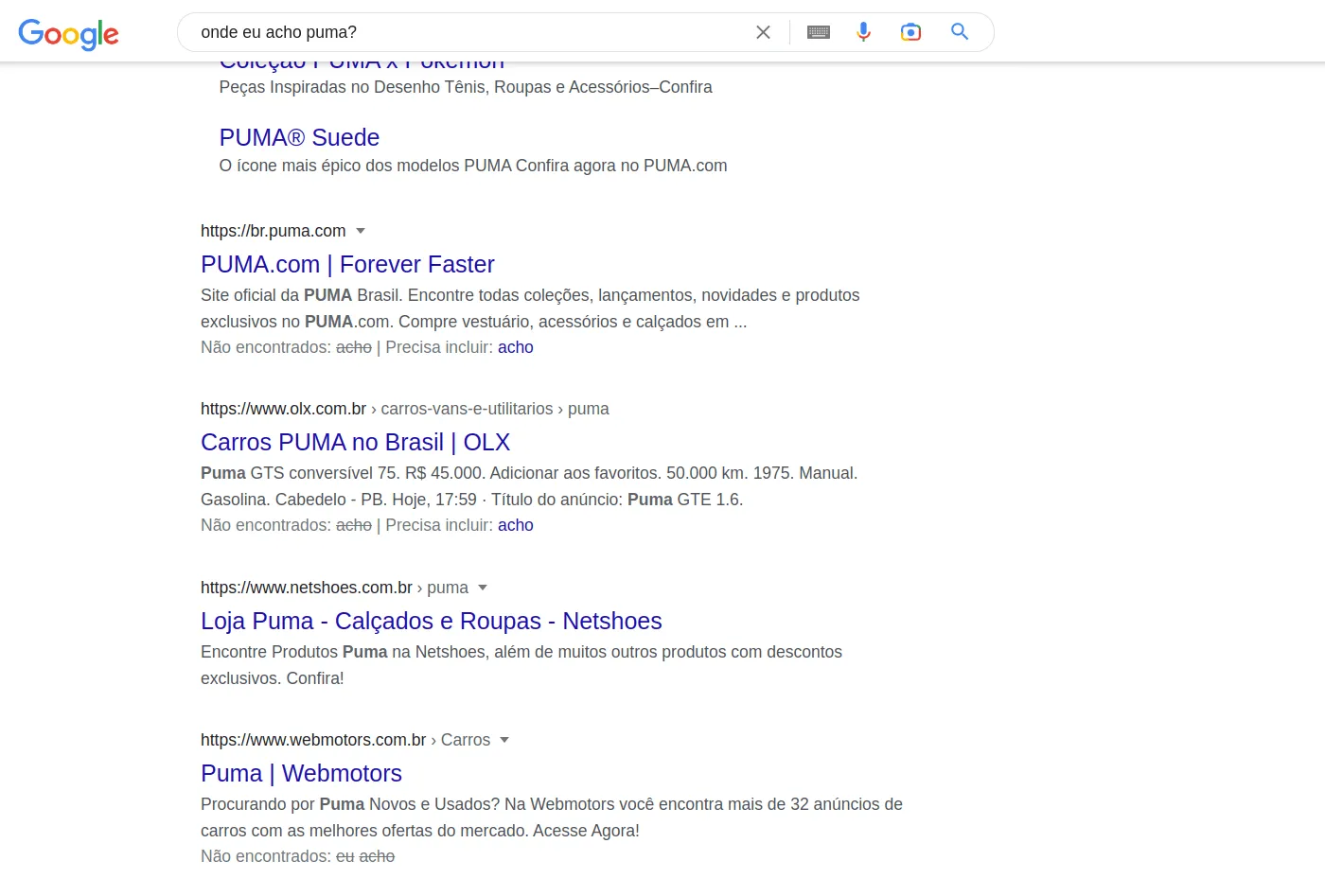
When I ask a question like: “where do I find puma?”, Google, for example, generates a search of this type:
In the image, search on the Google website using the descriptor “where do I find puma?”. Source: author of this article. It is clear to see that, due to my history—which does not feature a car and does not make searches for it—the algorithm has more confidence that the entity “puma” is related to the sports brand, less for cars, and none for the puma animal.
Did you know that I created a Definition Generator Spreadsheet to help you create yours using my personalized prompt?
Therefore, what we call disambiguation in Information Science was performed.
Wikipedia defines disambiguation as follows:
In linguistics, disambiguation refers to the process of explaining a message that has more than one meaning. An ambiguous term is, therefore, one that brings a confusing message or instruction and can be interpreted in more than one way.
Wikipedia Brasil I have already written about this here on the Blog in the post The importance of disambiguation in Semântico SEO .
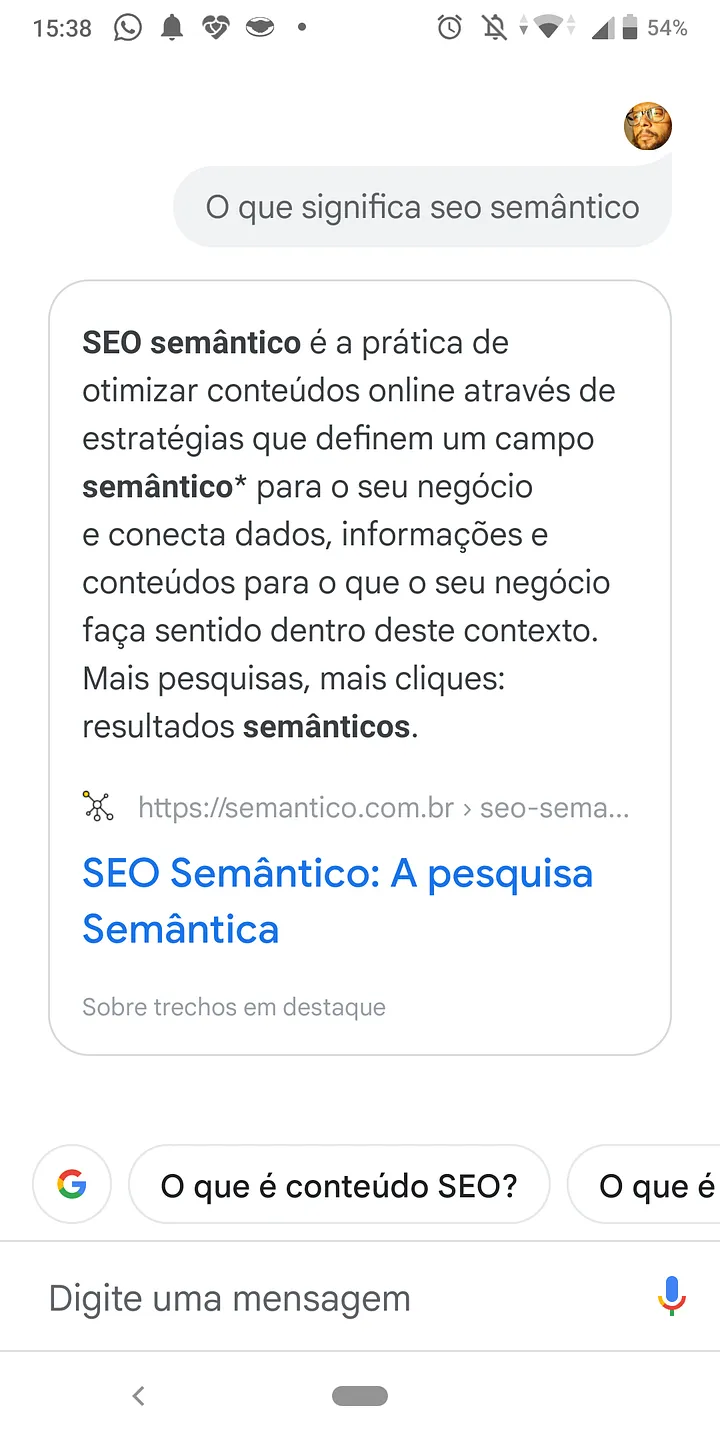
Another example of an optimized result, this time using voice search:
Representation of a search made by Google’s voice recognition engine, the question in query is “what does semantic seo mean”, with the definition of Semântico SEO already presented according to the website “seosemantico.com.br”. The definition I created, based on my perspective of what Semântico SEO is, generated this result.
Marcelo Schiessl and Marisa Brascher in Ontologia: ambiguidade e precisão , state that ambiguity is a major obstacle to information retrieval.
Therefore, any and all help we can give to our algorithmic reader (search engines, primarily) helps in this process of escaping uncertainty, making it clearer to retrieval tools which specific topic we want to know about.
And one of the simplest ways to do this is to deal with precise definitions about the concepts, terms, and entities that are present in our texts.
The process of defining entities If I state that the i4 is an electric car created by BMW in one sentence, in another I can state that the German factory BMW’s release of the year is the first Electric Gran Coupé. Both are true facts about the same entity.
However, we will not use every type of definition in SEO; the type of definition that interests us is the one used in terminological dictionaries:
Terminological definitions predominantly bring formal knowledge about “things” or phenomena.
(FINATTO, 1998, p. 2) The terminological definition presents the following characteristics:
Domain adequacy; Formal structure and conceptual organization of the definitional statement; Proximate genus + specific differences* I have written many times here on the Semântico SEO Blog about domain (domain of knowledge, semantic domain). Linguistic anthropology has one approach, lexicography another, but it is the perspective of the Social Sciences that helps us.
The search was originally to see how terms that groups of humans use to describe certain things are relative to the underlying perceptions and meanings that these groups share.
Ethnosemantics became the field that focused around the study of these semantic domains and, more specifically, the study of how categorization and the context of terms and groups of terms reflected the ways in which different cultures categorize terms in discourse and attribute meaning to their language.
OTTENHEIMER, 2006, P. 18 But before continuing, I need to emphasize the importance of item 3: proximate genus + specific differences. It acts as a guide to begin the process of defining our concepts, terms, and entities. Let us look at an example:
“An electric car is a motor vehicle powered by electrical energy.”
In this example, the term “motor vehicle” represents the proximate genus, as it is the closest genus (and higher in the hierarchy) to electric car. If we think of a vehicle taxonomy, we might have something like this:
My proposal is to use the methodology of Communicative Theory of Terminology to create formal definitions for your concepts, terms, and entities. These definitions can, and should, be stored in your taxonomy (or you can create a Thesaurus for your content), making this documentation useful for everyone who creates content in your organization.In short, the proposal is:
Start descriptions with formal definitions of entities because this helps the algorithm understand what we are talking about.
A standard for creating text for entities and categories does not mean texts devoid of creativity, but it helps us stay within our semantic field.
References
FINATTO, M. J. B. O papel da definição de termos técnico-científicos. lume.ufrgs.br, 2002. Available at http://hdl.handle.net/10183/184253. Accessed on: Feb. 4, 2023 RODRIGUES, Daniel de Sá. Definição terminológica: princípios e regras. periodicos.ufpa.br, 2020. Revista Moara, n. 55, jan-jul 2020. Available at http://dx.doi.org/10.18542/moara.v0i55.9040. Accessed on: Feb. 4, 2023.
bpedia.org/resource/Sinnesorgan”,”http://en.dbpedia.org/resource/Sensory_system”,”http://es.dbpedia.org/resource/Sistema_sensorial”,”http://fi.dbpedia.org/resource/Aistinelin”,”http://fr.dbpedia.org/resource/Système_sensoriel”,”http://hr.dbpedia.org/resource/Osjetilni_sustav”,”http://hu.dbpedia.org/resource/Érzékszerv”,”http://id.dbpedia.org/resource/Sistem_indera”,”http://is.dbpedia.org/resource/Athygli”,”http://it.dbpedia.org/resource/Organi_di_senso”,”http://lt.dbpedia.org/resource/Jutimo_organai”,”http://lv.dbpedia.org/resource/Maņu_orgānu_sistēma”,”http://nl.dbpedia.org/resource/Zintuigstelsel”,”http://no.dbpedia.org/resource/Sansesystem”,”http://pl.dbpedia.org/resource/Narządy_zmysłów”,”http://pt.dbpedia.org/resource/Sistema_sensorial”,”http://ro.dbpedia.org/resource/Sistem_senzorial”,”http://ru.dbpedia.org/resource/Сенсорная_система”,”http://sk.dbpedia.org/resource/Telesný_zmysel”,”http://sl.dbpedia.org/resource/Čutilo”,”http://sr.dbpedia.org/resource/Чулни_орган”,”http://sv.dbpedia.org/resource/Sinnesorgan”,”http://tr.dbpedia.org/resource/Duyu_sistemi”,”http://uk.dbpedia.org/resource/Сенсорна_система”],”types”:[“thing”]},”annotations”:{“urn:enhancement-4bcb8a55-e72a-4d76-9365-717bd0d1112c”:{“start”:3319,”end”:3324,”text”:”dados”}},”id”:”http://data.wordlift.io/wl01797/entity/dado”,”label”:”Dado”,”mainType”:”thing”,”occurrences”:[“urn:enhancement-4bcb8a55-e72a-4d76-9365-717bd0d1112c”],”sameAs”:[“http://dbpedia.org/resource/Dice”,”http://rdf.freebase.com/ns/m.029b3″],”types”:[“thing”]},”annotations”:{“urn:enhancement-7c5836b4-464d-490a-9cd2-730a5e0e0b90”:{“start”:3541,”end”:3562,”text”:”ENTIDADE (INFORMÁTICA”}},”id”:”http://data.wordlift.io/wl01797/entity/entidade_informatica”,”label”:”Entidade (informática)”,”mainType”:”thing”,”occurrences”:[“urn:enhancement-7c5836b4-464d-490a-9cd2-730a5e0e0b90″],”sameAs”:[“http://pt.dbpedia.org/resource/Entidade_(informática)”],”types”:[“thing”]},”annotations”:{“urn:enhancement-b32aaa48-fa45-47d1-944e-50f6348287af”:{“start”:3015,”end”:3021,”text”:”termos”},”urn:enhancement-5afc133a-7e5b-46ef-af7c-aa5620afdc59″:{“start”:9320,”end”:9326,”text”:”termos”},”urn:enhancement-9ded31d1-95a4-4712-9a3f-f996176529bb”:{“start”:6859,”end”:6865,”text”:”termos”},”urn:enhancement-f159dcdd-c6ac-4248-8c1f-a9eb2af63349″:{“start”:11309,”end”:11315,”text”:”termos”},”urn:enhancement-9738162b-e635-4c1f-aa9f-c192ba0cf1e1″:{“start”:5618,”end”:5624,”text”:”termos”},”urn:enhancement-09f91341-4e49-4181-92f3-77ae157ced40″:{“start”:6001,”end”:6007,”text”:”termos”},”urn:enhancement-440f4548-fa33-4b66-8289-51cadd6bbe0c”:{“start”:2653,”end”:2659,”text”:”termos”},”urn:enhancement-1b2b7b3d-3b88-47c8-9c5c-230578fe7ab6″:{“start”:4228,”end”:4234,”text”:”termos”},”urn:enhancement-a1aa2806-04f6-4fbf-ad97-357d6bcc3731″:{“start”:13430,”end”:13436,”text”:”termos”},”urn:enhancement-f5c96a0d-9471-422a-9d98-22f28241d814″:{“start”:4774,”end”:4780,”text”:”termos”},”urn:enhancement-69469dad-6b78-443f-9d58-3fc18904b0ca”:{“start”:2906,”end”:2912,”text”:”termos”}},”id”:”http://data.wordlift.io/wl01797/entity/palavra-chave”,”label”:”Palavra-chave”,”mainType”:”thing”,”occurrences”:[“urn:enhancement-440f4548-fa33-4b66-8289-51cadd6bbe0c”,”urn:enhancement-69469dad-6b78-443f-9d58-3fc18904b0ca”,”urn:enhancement-b32aaa48-fa45-47d1-944e-50f6348287af”,”urn:enhancement-1b2b7b3d-3b88-47c8-9c5c-230578fe7ab6″,”urn:enhancement-f5c96a0d-9471-422a-9d98-22f28241d814″,”urn:enhancement-9738162b-e635-4c1f-aa9f-c192ba0cf1e1″,”urn:enhancement-09f91341-4e49-4181-92f3-77ae157ced40″,”urn:enhancement-9ded31d1-95a4-4712-9a3f-f996176529bb”,”urn:enhancement-5afc133a-7e5b-46ef-af7c-aa5620afdc59″,”urn:enhancement-f159dcdd-c6ac-4248-8c1f-a9eb2af63349″,”urn:enhancement-a1aa2806-04f6-4fbf-ad97-357d6bcc3731″],”sameAs”:[“http://bg.dbpedia.org/resource/Ключоva_дума”,”http://cs.dbpedia.org/resource/Deskriptor”,”http://dbpedia.org/resource/Index_term”,”http://de.dbpedia.org/resource/Deskriptor”,”http://en.dbpedia.org/resource/Index_term”,”http://es.dbpedia.org/resource/Encabezamientos_de_materia”,”http://fi.dbpedia.org/resource/Avainsana”,”http://fr.dbpedia.org/resource/Mot_clé_(sciences_de_l’information_et_des_bibliothèques)”,”http://hr.dbpedia.org/resource/Deskriptor_(informacijske_znanosti)”,”http://id.dbpedia.org/resource/Kata_kunci”,”http://it.dbpedia.org/resource/Descrittore_(informazione)”,”http://lv.dbpedia.org/resource/Atslēgvārds_(informācijas_meklēšana)”,”http://pl.dbpedia.org/resource/Keyword”,”http://pt.dbpedia.org/resource/Palavra-chave”,”http://rdf.freebase.com/ns/m.0fr1w6″,”http://ru.dbpedia.org/resource/Ключевое_слово”,”http://uk.dbpedia.org/resource/Ключове_слово”],”types”:[“thing”]},”annotations”:{“urn:enhancement-3092cdd7-8bf9-44d5-aeb7-30faaf676d89”:{“start”:2946,”end”:2956,”text”:”tecnologia”},”urn:enhancement-b7288207-4038-49cd-9d45-dc43a4b7fb01″:{“start”:13140,”end”:13150,”text”:”tecnologia”}},”id”:”http://data.wordlift.io/wl01797/entity/tecnologia”,”label”:”Tecnologia”,”mainType”:”creative-work”,”occurrences”:[“urn:enhancement-3092cdd7-8bf9-44d5-aeb7-30faaf676d89″,”urn:enhancement-b7288207-4038-49cd-9d45-dc43a4b7fb01″],”sameAs”:[“http://be.dbpedia.org/resource/Тэхналогія”,”http://bg.dbpedia.org/resource/Технология”,”http://ca.dbpedia.org/resource/Tecnologia”,”http://cs.dbpedia.org/resource/Technologie”,”http://da.dbpedia.org/resource/Teknologi”,”http://dbpedia.org/resource/Technology”,”http://de.dbpedia.org/resource/Technologie”,”http://en.dbpedia.org/resource/Technology”,”http://es.dbpedia.org/resource/Tecnología”,”http://et.dbpedia.org/resource/Tehnoloogia”,”http://fi.dbpedia.org/resource/Teknologia”,”http://fr.dbpedia.org/resource/Technologie”,”http://hr.dbpedia.org/resource/Tehnologija”,”http://hu.dbpedia.org/resource/Technológia”,”http://id.dbpedia.org/resource/Teknologi”,”http://is.dbpedia.org/resource/Tækni”,”http://it.dbpedia.org/resource/Tecnologia”,”http://lt.dbpedia.org/resource/Technologija”,”http://lv.dbpedia.org/resource/Tehnoloģija”,”http://nl.dbpedia.org/resource/Technologie”,”http://no.dbpedi
a.org/resource/Teknologi”,”http://pl.dbpedia.org/resource/Technologia”,”http://pt.dbpedia.org/resource/Tecnologia”,”http://rdf.freebase.com/ns/m.07c1v”,”http://ro.dbpedia.org/resource/Tehnologie”,”http://ru.dbpedia.org/resource/Технология”,”http://sk.dbpedia.org/resource/Technológia”,”http://sl.dbpedia.org/resource/Tehnologija”,”http://sr.dbpedia.org/resource/Технологија”,”http://sv.dbpedia.org/resource/Teknologi”,”http://tr.dbpedia.org/resource/Teknoloji”,”http://uk.dbpedia.org/resource/Технологія”],”types”:[“creative-work”]},”annotations”:{“urn:enhancement-792ce575-4822-4eeb-99ee-61ae2541e15f”:{“start”:592,”end”:597,”text”:”search”},”urn:enhancement-e64980d0-12a5-47c4-aa94-c428d036fe94″:{“start”:10599,”end”:10604,”text”:”search”},”urn:enhancement-8a685a9e-f48c-44f2-9ad9-264cb8b3f7d1″:{“start”:1899,”end”:1904,”text”:”search”},”urn:enhancement-df8c785d-ccac-4bf2-ae0a-d351c7560674″:{“start”:13256,”end”:13261,”text”:”search”},”urn:enhancement-1ef02a84-2167-4273-858a-65fe760bd0a4″:{“start”:7690,”end”:7700,”text”:”optimization”},”urn:enhancement-34801e14-394a-4022-8cbd-5e6b7c6a794f”:{“start”:130,”end”:149,”text”:”site optimization”}},”id”:”http://data.wordlift.io/wl01797/entity/otimizacao”,”label”:”Optimization”,”mainType”:”creative-work”,”occurrences”:[“urn:enhancement-34801e14-394a-4022-8cbd-5e6b7c6a794f”,”urn:enhancement-792ce575-4822-4eeb-99ee-61ae2541e15f”,”urn:enhancement-8a685a9e-f48c-44f2-9ad9-264cb8b3f7d1″,”urn:enhancement-1ef02a84-2167-4273-858a-65fe760bd0a4″,”urn:enhancement-e64980d0-12a5-47c4-aa94-c428d036fe94″,”urn:enhancement-df8c785d-ccac-4bf2-ae0a-d351c7560674″],”sameAs”:[“http://bg.dbpedia.org/resource/Математическа_оптимизация”,”http://ca.dbpedia.org/resource/Optimització_matemàtica”,”http://cs.dbpedia.org/resource/Optimalizace_(matematika)”,”http://da.dbpedia.org/resource/Optimering_(matematik)”,”http://data.wordlift.io/wl0221/entity/algoritmo_de_busca”,”http://data.wordlift.io/wl0221/entity/otimizacao”,”http://dbpedia.org/resource/Mathematical_optimization”,”http://de.dbpedia.org/resource/Optimierung_(Mathematik)”,”http://en.dbpedia.org/resource/Mathematical_optimization”,”http://es.dbpedia.org/resource/Optimización_(matemática)”,”http://fi.dbpedia.org/resource/Matemaattinen_optimointi”,”http://fr.dbpedia.org/resource/Optimisation_(mathématiques)”,”http://hr.dbpedia.org/resource/Optimizacija_(matematika)”,”http://hu.dbpedia.org/resource/Matematikai_optimalizálás”,”http://id.dbpedia.org/resource/Optimisasi”,”http://it.dbpedia.org/resource/Ottimizzazione_(matematica)”,”http://lt.dbpedia.org/resource/Optimizavimas_(matematika)”,”http://nl.dbpedia.org/resource/Wiskundige_optimalisatie”,”http://no.dbpedia.org/resource/Optimering”,”http://pl.dbpedia.org/resource/Optymalizacja_(matematyka)”,”http://pt.dbpedia.org/resource/Otimização”,”http://rdf.freebase.com/ns/m.0dpl_”,”http://ro.dbpedia.org/resource/Optimizare”,”http://ru.dbpedia.org/resource/Оптимизация_(математика)”,”http://sk.dbpedia.org/resource/Optimalizácia_(matematika)”,”http://sl.dbpedia.org/resource/Optimizacija_(matematika)”,”http://sr.dbpedia.org/resource/Оптимизација_(математика)”,”http://sv.dbpedia.org/resource/Optimeringslära”,”http://tr.dbpedia.org/resource/Optimizasyon”,”http://uk.dbpedia.org/resource/Оптимізація_(математика)”],”types”:[“creative-work”]},”annotations”:{“urn:enhancement-460d008d-b3e0-4135-b7c9-9a0c3451ab50”:{“start”:12269,”end”:12275,”text”:”pattern”},”urn:enhancement-56b37229-c882-41ba-a368-07c937c3438d”:{“start”:13823,”end”:13829,”text”:”pattern”}},”id”:”http://data.wordlift.io/wl01797/entity/padroes”,”label”:”Patterns”,”mainType”:”thing”,”occurrences”:[“urn:enhancement-460d008d-b3e0-4135-b7c9-9a0c3451ab50″,”urn:enhancement-56b37229-c882-41ba-a368-07c937c3438d”],”sameAs”:[“http://dbpedia.org/resource/Pattern”,”http://de.dbpedia.org/resource/Muster_(Struktur)”,”http://en.dbpedia.org/resource/Pattern”,”http://es.dbpedia.org/resource/Patrón_(estructura)”,”http://id.dbpedia.org/resource/Pola”,”http://nl.dbpedia.org/resource/Patroon_(vorm)”,”http://no.dbpedia.org/resource/Mønster”,”http://pt.dbpedia.org/resource/Padrão”,”http://ru.dbpedia.org/resource/Паттерн”,”http://tr.dbpedia.org/resource/Örüntü”,”http://uk.dbpedia.org/resource/Патерн”],”types”:[“thing”]},”annotations”:{“urn:enhancement-683cae33-9000-45cc-b10a-a798949602bb”:{“start”:9557,”end”:9571,”text”:”semantically”}},”id”:”http://data.wordlift.io/wl01797/entity/analise_semantica”,”label”:”Semantic analysis”,”mainType”:”thing”,”occurrences”:[“urn:enhancement-683cae33-9000-45cc-b10a-a798949602bb”],”sameAs”:[“http://data.wordlift.io/wl01797/entity/analise_semantica_2″,”http://dbpedia.org/resource/Semantic_analysis”,”http://pl.dbpedia.org/resource/Analiza_semantyczna”,”http://pt.dbpedia.org/resource/Análise_semântica”,”http://www.wikidata.org/entity/Q7449041″],”types”:[“thing”]},”annotations”:{“urn:enhancement-cbcd92fe-a31a-4df6-9308-312b519f2bb2”:{“start”:12783,”end”:12786,”text”:”be”},”urn:enhancement-76dfc272-ba14-4f5c-856b-a6c0a6781687″:{“start”:11520,”end”:11523,”text”:”be”},”urn:enhancement-758bc684-a35e-4da3-856d-26d6e4491334″:{“start”:9553,”end”:9556,”text”:”be”},”urn:enhancement-46c2c0be-2290-43c3-bdec-d976ea1b1699″:{“start”:6562,”end”:6565,”text”:”be”},”urn:enhancement-ebbdbfa0-16d4-4d3c-9e58-6d554b3410d3″:{“start”:5166,”end”:5169,”text”:”be”},”urn:enhancement-559fefb9-b168-41a3-833d-6b70f80c1a3e”:{“start”:4115,”end”:4118,”text”:”be”},”urn:enhancement-ec0606b1-8654-44c0-92e6-b8de1a06e4e1″:{“start”:1516,”end”:1519,”text”:”be”},”urn:enhancement-920c2b48-81a2-43aa-ac5b-b5603ae4ded2″:{“start”:13483,”end”:13486,”text”:”be”}},”id”:”http://data.wordlift.io/wl01797/entity/ser”,”label”:”To be”,”mainType”:”thing”,”occurrences”:[“urn:enhancement-ec0606b1-8654-44c0-92e6-b8de1a06e4e1″,”urn:enhancement-559fefb9-b168-41a3-833d-6b70f80c1a3e”,”urn:enhancement-ebbdbfa0-16d4-4d3c-9e58-6d554b3410d3″,”urn:enhancement-46c2c0be-2290-43c3-bdec-d976ea1b1699″,”urn:enhancement-758bc684-a35e-4da3-856d-26d6e4491334″,”urn:enhancement-76dfc
{“translated_html”: “0a6781687\”,\”urn:enhancement-cbcd92fe-a31a-4df6-9308-312b519f2bb2\”,\”urn:enhancement-920c2b48-81a2-43aa-ac5b-b5603ae4ded2\”],\”sameAs\”:[\”http://bg.dbpedia.org/resource/Битие\”,\”http://cs.dbpedia.org/resource/Bytí\”,\”http://dbpedia.org/resource/Being\”,\”http://de.dbpedia.org/resource/Sein\”,\”http://en.dbpedia.org/resource/Being\”,\”http://es.dbpedia.org/resource/Ser\”,\”http://et.dbpedia.org/resource/Olemine\”,\”http://fi.dbpedia.org/resource/Oleminen\”,\”http://fr.dbpedia.org/resource/Être\”,\”http://hr.dbpedia.org/resource/Bitak\”,\”http://is.dbpedia.org/resource/Verund\”,\”http://it.dbpedia.org/resource/Essere\”,\”http://nl.dbpedia.org/resource/Zijn\”,\”http://pl.dbpedia.org/resource/Byt\”,\”http://pt.dbpedia.org/resource/Ser\”,\”http://ru.dbpedia.org/resource/Бытие\”,\”http://sk.dbpedia.org/resource/Bytie\”,\”http://sl.dbpedia.org/resource/Bivajoče\”,\”http://sr.dbpedia.org/resource/Биће\”,\”http://tr.dbpedia.org/resource/Varlık\”,\”http://uk.dbpedia.org/resource/Буття\”],\”types\”:[\”thing\”]},\”annotations\”:{\”urn:enhancement-aa38a67c-ba0f-4c79-803a-04c772b79da0\”:{\”start\”:13506,\”end\”:13515,\”text\”:\”taxonomy\”},\”urn:enhancement-77a6da77-c373-4165-9b44-6b7daaad0a32\”:{\”start\”:11609,\”end\”:11618,\”text\”:\”taxonomy\”}},\”id\”:\”http://data.wordlift.io/wl01797/entity/taxonomia\”,\”label\”:\”Taxonomy\”,\”mainType\”:\”creative-work\”,\”occurrences\”:[\”urn:enhancement-77a6da77-c373-4165-9b44-6b7daaad0a32\”,\”urn:enhancement-aa38a67c-ba0f-4c79-803a-04c772b79da0\”],\”sameAs\”:[\”http://ca.dbpedia.org/resource/Taxonomia\”,\”http://cs.dbpedia.org/resource/Taxonomie\”,\”http://dbpedia.org/resource/Taxonomy_(biology)\”,\”http://en.dbpedia.org/resource/Taxonomy_(biology)\”,\”http://es.dbpedia.org/resource/Taxonomía\”,\”http://et.dbpedia.org/resource/Taksonoomia\”,\”http://fi.dbpedia.org/resource/Taksonomia\”,\”http://fr.dbpedia.org/resource/Taxinomie\”,\”http://lt.dbpedia.org/resource/Taksonomija\”,\”http://lv.dbpedia.org/resource/Taksonomija\”,\”http://pt.dbpedia.org/resource/Taxonomia\”,\”http://rdf.freebase.com/ns/m.07hj0\”,\”http://ro.dbpedia.org/resource/Taxonomie_(biologie)\”,\”http://sk.dbpedia.org/resource/Taxonómia_(biológia)\”,\”http://sv.dbpedia.org/resource/Taxonomi\”],\”types\”:[\”creative-work\”]},\”annotations\”:{\”urn:enhancement-2ef4203d-4500-40bc-88b9-2eccca52ba9a\”:{\”start\”:10250,\”end\”:10263,\”text\”:\”knowledge\”},\”urn:enhancement-81c1b763-c8f7-4944-8280-bfe474d5e896\”:{\”start\”:3677,\”end\”:3689,\”text\”:\”knowledge\”},\”urn:enhancement-6e759b03-952d-4486-9565-190e44d09cde\”:{\”start\”:2744,\”end\”:2753,\”text\”:\”known\”},\”urn:enhancement-1bda17ae-8523-47b8-a5e5-f31e0959970f\”:{\”start\”:3049,\”end\”:3061,\”text\”:\”knowledge\”},\”urn:enhancement-24a9c5b3-86fd-4460-bf21-92f2341574e3\”:{\”start\”:4808,\”end\”:4820,\”text\”:\”knowledge\”},\”urn:enhancement-64f59bec-d63e-4074-925f-0d7757f6ced3\”:{\”start\”:10444,\”end\”:10456,\”text\”:\”knowledge\”},\”urn:enhancement-cfbb27d4-9454-41fd-8128-2d50a8f6ed78\”:{\”start\”:13284,\”end\”:13296,\”text\”:\”knowledge\”},\”urn:enhancement-d87792fe-8aa9-48ec-8a1d-d89082b03d80\”:{\”start\”:4997,\”end\”:5005,\”text\”:\”know\”}},\”id\”:\”http://data.wordlift.io/wl01797/entity/conhecimento\”,\”label\”:\”Knowledge\”,\”mainType\”:\”thing\”,\”occurrences\”:[\”urn:enhancement-6e759b03-952d-4486-9565-190e44d09cde\”,\”urn:enhancement-1bda17ae-8523-47b8-a5e5-f31e0959970f\”,\”urn:enhancement-81c1b763-c8f7-4944-8280-bfe474d5e896\”,\”urn:enhancement-24a9c5b3-86fd-4460-bf21-92f2341574e3\”,\”urn:enhancement-d87792fe-8aa9-48ec-8a1d-d89082b03d80\”,\”urn:enhancement-2ef4203d-4500-40bc-88b9-2eccca52ba9a\”,\”urn:enhancement-64f59bec-d63e-4074-925f-0d7757f6ced3\”,\”urn:enhancement-cfbb27d4-9454-41fd-8128-2d50a8f6ed78\”],\”sameAs\”:[\”http://be.dbpedia.org/resource/Веды\”,\”http://bg.dbpedia.org/resource/Знание\”,\”http://ca.dbpedia.org/resource/Coneixement\”,\”http://cs.dbpedia.org/resource/Poznatek\”,\”http://da.dbpedia.org/resource/Viden\”,\”http://dbpedia.org/resource/Knowledge\”,\”http://de.dbpedia.org/resource/Wissen\”,\”http://en.dbpedia.org/resource/Knowledge\”,\”http://es.dbpedia.org/resource/Conocimiento\”,\”http://et.dbpedia.org/resource/Teadmine\”,\”http://fi.dbpedia.org/resource/Tieto\”,\”http://fr.dbpedia.org/resource/Connaissance\”,\”http://hr.dbpedia.org/resource/Znanje\”,\”http://hu.dbpedia.org/resource/Ismeret\”,\”http://id.dbpedia.org/resource/Pengetahuan\”,\”http://is.dbpedia.org/resource/Þekking\”,\”http://it.dbpedia.org/resource/Conoscenza\”,\”http://lt.dbpedia.org/resource/Žinios\”,\”http://lv.dbpedia.org/resource/Zināšanas\”,\”http://nl.dbpedia.org/resource/Kennis\”,\”http://no.dbpedia.org/resource/Kunnskap\”,\”http://pl.dbpedia.org/resource/Wiedza\”,\”http://pt.dbpedia.org/resource/Conhecimento\”,\”http://rdf.freebase.com/ns/m.01k8wb\”,\”http://ro.dbpedia.org/resource/Cunoaștere\”,\”http://ru.dbpedia.org/resource/Знание\”,\”http://sk.dbpedia.org/resource/Vedenie_(filozofia)\”,\”http://sl.dbpedia.org/resource/Znanje\”,\”http://sq.dbpedia.org/resource/Dituria\”,\”http://sr.dbpedia.org/resource/Знање\”,\”http://sv.dbpedia.org/resource/Kunskap\”,\”http://tr.dbpedia.org/resource/Bilgi\”,\”http://uk.dbpedia.org/resource/Знання\”],\”types\”:[\”thing\”]},\”annotations\”:{\”urn:enhancement-18100f48-733d-4537-a048-3e3bf9eb0210\”:{\”start\”:10935,\”end\”:10948,\”text\”:\”categorization\”}},\”id\”:\”http://data.wordlift.io/wl01797/entity/categorizacao-6640\”,\”label\”:\”Categorization\”,\”mainType\”:\”thing\”,\”occurrences\”:[\”urn:enhancement-18100f48-733d-4537-a048-3e3bf9eb0210\”],\”sameAs\”:[\”http://dbpedia.org/resource/Categorization\”,\”http://rdf.freebase.com/ns/m.0jl8r\”,\”http://www.wikidata.org/entity/Q912550\”],\”types\”:[\”thing\”]},\”annotations\”:{\”urn:enhancement-7e21f95e-7797-4af6-ba19-86bb93d99acb\”:{\”start\”:13197,\”end\”:13205,\”text\”:\”content\”},\”urn:enhancement-a4006f4f-feb4-4392-8cae-a4b79dd9c55c\”:{\”start\”:13622,\”end\”:13630,\”text\”:\”content\”},\”urn:enhancement-a58b17a8-781e-45e8-82b1-dc17751ebfea\”:{\”start\”:13558,\”end\”:13566,\”text\”:\”content\”},\”urn:enhancement-367bf795-9bb9-45c0-a658-55eed3dae251\”:{\”start\”:12532,\”end\”:12540,\”text\”:\”content\”},\”urn:enhancement-a6d859d0-d4fa-451d-9144-e74c1259d4f5\”:{\”start\”:8541,\”end\”:8549,\”text\”:\”content\”},\”urn:enhancement-e3c16a8c-a1a6-4a02-82a1-45bdb7ceb883\”:{\”start\”:12684,\”end\”:12692,\”}”}
{“translated_html”: “”}
tp://rdf.freebase.com/ns/m.06cs1″,”http://ro.dbpedia.org/resource/Cercetare”,”http://ru.dbpedia.org/resource/Исследование”,”http://sl.dbpedia.org/resource/Raziskovalna_dejavnost”,”http://sr.dbpedia.org/resource/Истраживање”,”http://sv.dbpedia.org/resource/Forskning”,”http://tr.dbpedia.org/resource/Araştırma”,”http://uk.dbpedia.org/resource/Дослідження”],”types”:[“thing”]}]} /–>