
What is a Semantic Field and how to use it in SEO?
In this article, I want to discuss a subject that may seem alien to our field of work: the Semantic Field, and demonstrate that...
SEO, in very simple terms, is optimizing your website so that Google understands it. You can understand optimization as improving the website’s code, the user experience, the content of the pages, and what you put, for example, on your blog.
Semantic SEO, on the other hand, is the practice of optimizing online content through strategies that define a semantic field for your business and connect data, information, and content so that your business makes sense within this context. More searches, more clicks: semantic results.
Índice Controlado de Termos
In this article, I want to discuss a subject that may seem alien to our field of work: the Semantic Field, and demonstrate that...
Today we see an enormous profusion of tools, strategies, models, and different applications in our old (and tired) SEO. Many of these offer a...
In this video, Felipe Bazon and I discuss Semantic SEO and I share my experience working with SEO, beginning the conversation from the early days of the internet through becoming an SEO specialist. It was a very interesting conversation in which we discuss how Semantic SEO involves optimizing content based on the meaning of words, taking into account context and different meanings.
This is another post based on videos I recorded some time ago, in which I shared on YouTube and LinkedIn some of the questions...
This is another post that was based on some videos I recorded a while ago in which I shared on YouTube and LinkedIn some...
The first in the series of questions that I ask myself and want to share with you was prompted by this book I am...
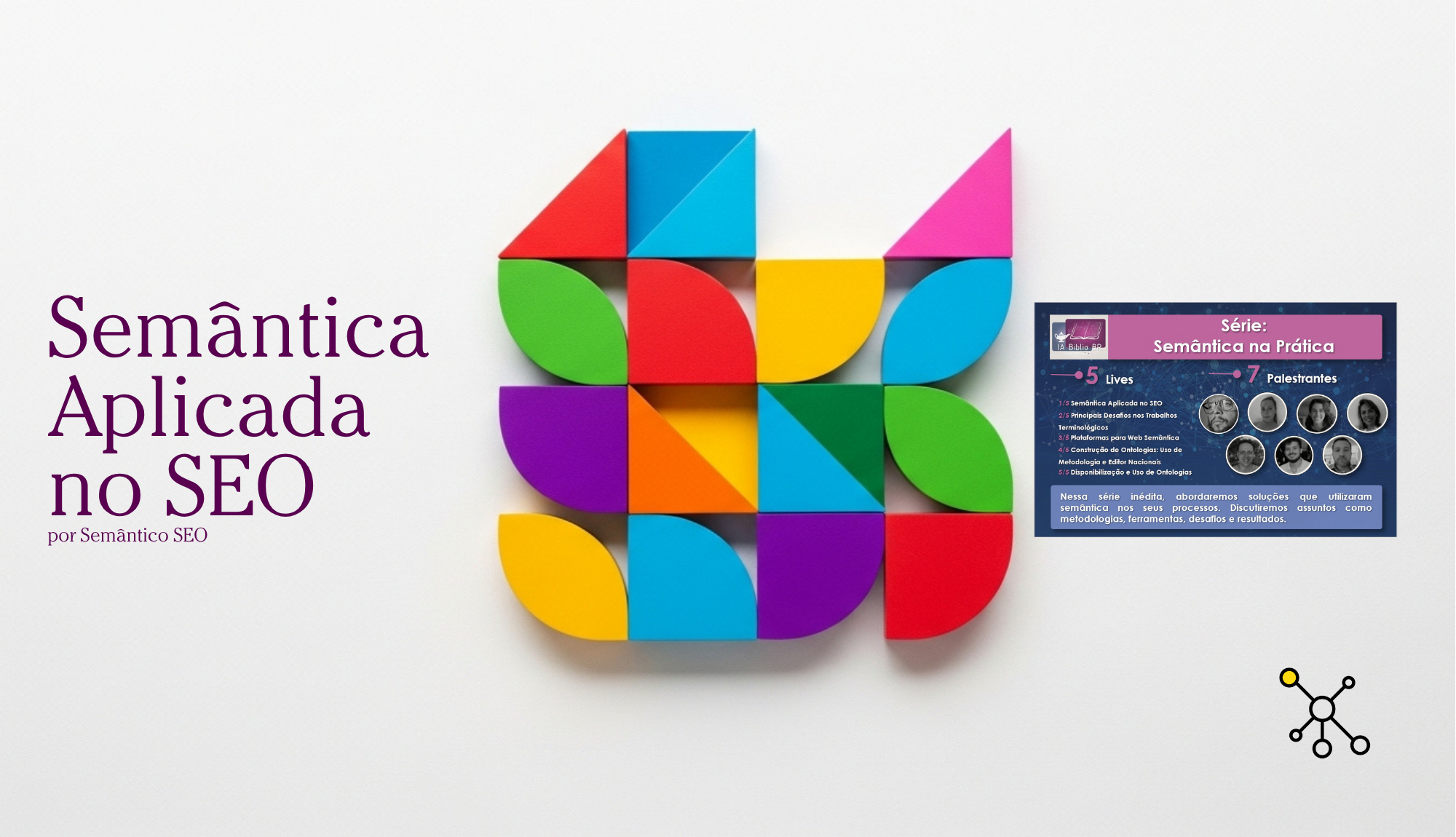
In the first live session of the series, Alexander Rodrigues will present a case study that used WordLift, a Semantic SEO tool that utilizes...
Google has just confirmed the release of a broad update today: A new broad core update will begin rolling out on Wednesday—this one called the June 2021 Core Update, announced Google search liaison Danny Sullivan, adding that we should also expect a July 2021 core update next month. Here, my training (in progress) as a Librarian speaks louder: for content to be published, it must meet certain criteria such as expertise, authority on the subject, reliability of sources and information, and originality.
Before answering how to work with SEO, I want you to set aside some time to watch this film. You don't need to attend any college to start working with SEO, but you do need to develop some important skills, such as writing for the Web, technical knowledge of website development (though you don't necessarily need to be a developer), in-depth understanding of how search engines and algorithms work, data analysis, among other skills.
Come talk with me about SEO and the Semantic Web!
A taxonomy for companies. That is the proposal. A taxonomy, put very simply, is a categorization scheme. It was created to organize items into...
You will at some point soon encounter a knowledge graph. It is also possible to create advanced applications and dashboards that generate high value for the organization, but to do so we need to expand data integration, providing data to those who need it, over time.
It is often extremely complicated to understand these connections, which is why we use Knowledge Graphs to represent these relationships in a graphical, visual, and understandable way. As researchers in a digital world, we navigate using search engines that index our information, but remove its meaning and context.
In this post, I will present several results achieved on real websites using a new approach to SEO: Semantic Optimization. Semantic optimization and its advanced results. In the graph above, the most impactful result we achieved: placing content published two days prior on Google Discover.
Semantic Field and SEO: the definition of a semantic field for an SEO project is fundamental for any advanced optimization project today.
SEO since its inception has been a constant mutant. Today there is a lot of talk about SEO and AEO, with the latter being a natural evolution of the former. Engine Optimization.
Creating OWL for Business is about making use of a language to define and instantiate ontologies on the Web. OWL (Web Ontology Language) is an essential ingredient in this stack, and the need for ontologists is increasing faster than the number and variety of resources available for learning OWL.
How to rank on Google? It is necessary to create content that is relevant according to your user's search intent.
This post is a case study that demonstrates the power of Semantic SEO to generate results for your business. Click on the link to find out how!