Arquiteto de Informação e Engenheiro de Engenharia de Busca Semântica
calendar_today
24 de November, 2026 •timer
22 min de leitura
•Revisão por Pares: Sim
Semantic SEO differs from old optimization strategies by being strongly based on the meaning of what is discussed in the content; therefore, eliminating the double meaning of a phrase (called disambiguation) is one of the first steps that need to be taken when starting a semantic optimization project.
In linguistics, disambiguation is the process of clarifying the meaning of something that has multiple possible interpretations, eliminating ambiguity. It is the action of making clear the meaning of a term, phrase, or concept that can be understood in more than one way.
Therefore, in the Semantic Workflow that I created, right after finding the knowledge domain in which your project is embedded, we begin building a taxonomy, because it helps us define, without ambiguity, the concepts and terms that will be used. Thus, the action or process that eliminates the ambiguity of a linguistic structure, helping us make its real meanings explicit, is one of the fundamental elements of Semantic SEO.
What is the relationship between SEO and ambiguity?
To be direct, the relationship lies in information retrieval.
SEO works on the constant and methodical improvement of the content we put on the internet. By content, I mean the set of posts, pages, tools, platforms, and others. Everything your organization puts on the internet is, to me, content. And our work as SEO professionals is to help with the retrieval of information contained within that content.
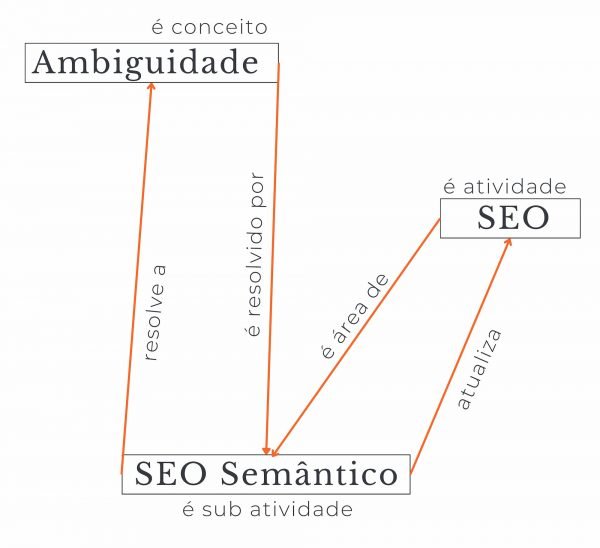
If I am writing content about ambiguity and Semantic SEO, I can establish both at the text level and within the structured data connected to the HTML of this text the relationships between these three entities:
Ambiguity
SEO
Semantic SEO
Described roughly as follows:
The relationship I create between the three entities can be described in this simple representation in several ways, depending on the knowledge domain where my site is situated, the content structure I chose to use, the taxonomy I customized for the project, and many other criteria.
However, something that does not change is the fact that the connections between them carry meaning—they are semantic. And semantic applications that use, for instance, natural language processing and other artificial intelligence techniques can transform this structure into a knowledge graph.
How do I use knowledge graphs to resolve ambiguity?
Artificial intelligence, taxonomies and internal links
In this post you are reading right now, there is a small excerpt of a created knowledge graph. I use WordLift to connect the taxonomy I customized for my site with the entities I described in the form of a controlled vocabulary, generating an internal link network enriched with structured data through artificial intelligence, connected to a data base such as DBpedia.
This allowed me to create an internal Knowledge Graph specialized in Semantic SEO and its relationship with Library Science and Information Science, the new focus of my work and this blog.
How Semantic SEO and taxonomies help perform disambiguation in your projects
We can divide the objectives of generating certainty about the concepts you address in your content into two:
User search intent and improvement in search results.
In both cases, the Semantic Workflow methodology helps you move forward more securely throughout the entire process.
User intent
With each search made by each user at a given time, we can categorize by types, which we currently call intents.
There are four user search intents:
Informational: the visitor wants to find an answer to a specific question.
Navigational: the visitor wants to find a specific page or site.
Commercial: the visitor wants to investigate brands or services.
Transactional: the visitor wants to complete an action (conversion).
This is a way for us to organize, in a logical manner, what we understand as an information search moment, where all previous interactions are part of a set of decision-making steps, impacting the exact moment when the person needs to accomplish something and goes to a search engine or a site to perform a search.
Whether searching on Google or going straight to the internal search mechanism of your site, this person has a more or less defined goal that guides how they search and what they consider useful information. It is at this point that the prior organization of information by the team involved in the projects (whether building platforms or content) has a direct impact on delivering this information relevant to each user intent.
The use of taxonomies at the beginning of your project helps focus on what is important for your company to communicate about the domain of the When you perform a search on either of them, you trigger algorithms that navigate in microseconds through these semantic networks, composed of trillions of concepts, entities and their relations, seeking to bring the best answer to your query.
The level of certainty regarding the best information to answer your question may vary: algorithms like MUM have delivered increasingly better and more complete results. But one thing is certain: for search engines to continue evolving, answers need to be ever more precise.
Disambiguation is the process of removing ambiguity from terms, concepts, and entities within an information architecture. In Semântico SEO, this practice forms the foundation of knowledge graphs, ensuring that search engines and generative models correctly interpret the intent behind every query fan-out.
[“creative-work”]
knowledge graph”},”urn:enhancement-35e2eb6d-c33e-4b0f-97dc-389918a53262″:{“start”:7835,”end”:7856,”text”:”knowledge graph”}},”id”:”http://data.wordlift.io/wl0221/entity/grafo-do-conhecimento”,”label”:”Knowledge graph”,”mainType”:”thing”,”occurrences”:[“urn:enhancement-35e2eb6d-c33e-4b0f-97dc-389918a53262″,”urn:enhancement-a2783d1c-3fde-4225-9948-063176c53c2e”],”sameAs”:[“http://data.wordlift.io/wl0221/entity/grafo__do_conhecimento”,”http://data.wordlift.io/wl0221/entity/grafo_do_conhecimento”],”types”:[“thing”]},{“annotations”:{“urn:enhancement-cf052e1d-2b21-4f9a-ae64-07de74ff7153”:{“start”:13077,”end”:13087,”text”:”ontologies”},”urn:enhancement-44ed2d07-a804-4a46-b0e4-0912e077abc7″:{“start”:3836,”end”:3846,”text”:”ontologies”},”urn:enhancement-003fd87c-c103-4666-99b9-8141b24d328c”:{“start”:5041,”end”:5051,”text”:”ontologies”}},”id”:”http://data.wordlift.io/wl0221/entity/ontologia-ciencia-da-computacao”,”label”:”Ontology (computer science)”,”mainType”:”thing”,”occurrences”:[“urn:enhancement-44ed2d07-a804-4a46-b0e4-0912e077abc7″,”urn:enhancement-003fd87c-c103-4666-99b9-8141b24d328c”,”urn:enhancement-cf052e1d-2b21-4f9a-ae64-07de74ff7153″],”sameAs”:[“http://data.wordlift.io/wl01797/entity/ontologia_ciencia_da_computacao”,”http://data.wordlift.io/wl0221/entity/ontologia_ciencia_da_computacao”,”http://dbpedia.org/resource/Ontology_(information_science)”,”http://rdf.freebase.com/ns/m.0d66m”],”types”:[“thing”]},{“annotations”:{“urn:enhancement-e3841a91-6df0-4299-872a-871b7ad9f66f”:{“start”:4748,”end”:4761,”text”:”Semantic Web”}},”id”:”http://data.wordlift.io/wl0221/entity/web-semantica”,”label”:”Semantic Web”,”mainType”:”creative-work”,”occurrences”:[“urn:enhancement-e3841a91-6df0-4299-872a-871b7ad9f66f”],”sameAs”:[“http://bg.dbpedia.org/resource/Семантична_мрежа”,”http://ca.dbpedia.org/resource/Web_semàntic”,”http://cs.dbpedia.org/resource/Sémantický_web”,”http://da.dbpedia.org/resource/Semantisk_web”,”http://data.wordlift.io/wl01797/entity/web_semantica”,”http://dbpedia.org/resource/Semantic_Web”,”http://de.dbpedia.org/resource/Semantic_Web”,”http://en.dbpedia.org/resource/Semantic_Web”,”http://es.dbpedia.org/resource/Web_semántica”,”http://fi.dbpedia.org/resource/Semanttinen_Web”,”http://fr.dbpedia.org/resource/Web_sémantique”,”http://hu.dbpedia.org/resource/Szemantikus_web”,”http://id.dbpedia.org/resource/Web_semantik”,”http://is.dbpedia.org/resource/Merkingarvefur”,”http://it.dbpedia.org/resource/Web_semantico”,”http://lt.dbpedia.org/resource/Semantinis_tinklas”,”http://lv.dbpedia.org/resource/Semantiskais_tīmeklis”,”http://nl.dbpedia.org/resource/Semantisch_web”,”http://no.dbpedia.org/resource/Semantisk_web”,”http://pl.dbpedia.org/resource/Semantic_Web”,”http://pt.dbpedia.org/resource/Web_semântica”,”http://rdf.freebase.com/ns/m.076k0″,”http://ru.dbpedia.org/resource/Семантическая_паутина”,”http://sr.dbpedia.org/resource/Семантички_веб”,”http://sv.dbpedia.org/resource/Semantiska_webben”,”http://tr.dbpedia.org/resource/Anlamsal_ağ”,”http://uk.dbpedia.org/resource/Семантична_павутина”,”http://yago-knowledge.org/resource/Semantic_Web”],”types”:[“creative-work”]},{“annotations”:{“urn:enhancement-930ea33b-681c-4011-b205-b72d3138166f”:{“start”:14039,”end”:14049,”text”:”information”},”urn:enhancement-b57c9b14-0f47-4de8-aeb7-8b03fb422833″:{“start”:12990,”end”:13000,”text”:”information”},”urn:enhancement-064a722b-2d5f-40e9-a92f-a273bb6c8c58″:{“start”:12090,”end”:12100,”text”:”information”},”urn:enhancement-2848b12d-bbfc-4667-973b-65589ebec641″:{“start”:4128,”end”:4138,”text”:”information”},”urn:enhancement-17593aa4-06d7-47ca-b54d-3f098c254e4a”:{“start”:4260,”end”:4270,”text”:”information”},”urn:enhancement-d7df7395-87f9-4670-bad3-57eb3a5efc2c”:{“start”:2838,”end”:2848,”text”:”information”},”urn:enhancement-c7707972-b445-4754-bfff-42cafc8fad61″:{“start”:12149,”end”:12159,”text”:”information”},”urn:enhancement-9021fcfc-4a99-448e-a801-274afc039267″:{“start”:3618,”end”:3628,”text”:”information”},”urn:enhancement-0c52732e-7aa1-412f-91ae-4ddcc9535b03″:{“start”:12293,”end”:12303,”text”:”information”},”urn:enhancement-93c9ce7b-986d-4078-bed0-15e85c68b894″:{“start”:3522,”end”:3532,”text”:”information”},”urn:enhancement-91fec854-892e-4433-90f0-682d78994949″:{“start”:4405,”end”:4415,”text”:”information”},”urn:enhancement-1979e163-7f6b-4081-8b37-3b46a4c0c681″:{“start”:11152,”end”:11162,”text”:”information”}},”id”:”http://data.wordlift.io/wl0221/entity/informacao”,”label”:”Information”,”mainType”:”creative-work”,”occurrences”:[“urn:enhancement-d7df7395-87f9-4670-bad3-57eb3a5efc2c”,”urn:enhancement-93c9ce7b-986d-4078-bed0-15e85c68b894″,”urn:enhancement-9021fcfc-4a99-448e-a801-274afc039267″,”urn:enhancement-2848b12d-bbfc-4667-973b-65589ebec641″,”urn:enhancement-17593aa4-06d7-47ca-b54d-3f098c254e4a”,”urn:enhancement-91fec854-892e-4433-90f0-682d78994949″,”urn:enhancement-1979e163-7f6b-4081-8b37-3b46a4c0c681″,”urn:enhancement-064a722b-2d5f-40e9-a92f-a273bb6c8c58″,”urn:enhancement-c7707972-b445-4754-bfff-42cafc8fad61″,”urn:enhancement-0c52732e-7aa1-412f-91ae-4ddcc9535b03″,”urn:enhancement-b57c9b14-0f47-4de8-aeb7-8b03fb422833″,”urn:enhancement-930ea33b-681c-4011-b205-b72d3138166f”],”sameAs”:[“http://be.dbpedia.org/resource/Інфармацыя”,”http://bg.dbpedia.org/resource/Информация”,”http://ca.dbpedia.org/resource/Informació”,”http://cs.dbpedia.org/resource/Informace”,”http://da.dbpedia.org/resource/Information”,”http://data.wordlift.io/wl01797/entity/informacao”,”http://data.wordlift.io/wl01797/post/knowledge_graph_-_um_mundo_de_conexoes”,”http://data.wordlift.io/wl0221/entity/otimizacao_para_motores_de_busca”,”http://dbpedia.org/resource/Information”,”http://de.dbpedia.org/resource/Information”,”http://en.dbpedia.org/resource/Information”,”http://es.dbpedia.org/resource/Información”,”http://et.dbpedia.org/resource/Informatsioon”,”http://fi.dbpedia.org/resource/Informaatio”,”http://fr.dbpedia.org/resource/Information”,”http://hr.dbpedia.org/resource/Informacija”,”http://hu.dbpedia.org/resource/Információ”,”htt
p://id.dbpedia.org/resource/Informasi”,”http://is.dbpedia.org/resource/Upplýsingar”,”http://it.dbpedia.org/resource/Informazione”,”http://lt.dbpedia.org/resource/Informacija”,”http://lv.dbpedia.org/resource/Informācija”,”http://nl.dbpedia.org/resource/Informatie”,”http://no.dbpedia.org/resource/Informasjon”,”http://pl.dbpedia.org/resource/Informacja”,”http://pt.dbpedia.org/resource/Informação”,”http://rdf.freebase.com/ns/m.03y39″,”http://ro.dbpedia.org/resource/Informație”,”http://ru.dbpedia.org/resource/Информация”,”http://sk.dbpedia.org/resource/Informácia”,”http://sl.dbpedia.org/resource/Informacija”,”http://sq.dbpedia.org/resource/Informacioni”,”http://sr.dbpedia.org/resource/Информација”,”http://sv.dbpedia.org/resource/Information”,”http://tr.dbpedia.org/resource/Enformasyon”,”http://uk.dbpedia.org/resource/Інформація”],”types”:[“creative-work”]},”annotations”:{“urn:enhancement-ae042ec6-d189-4bdc-8305-0aab5666bbf6”:{“start”:11737,”end”:11743,”text”:”Google”},”urn:enhancement-9352313b-bf3a-4618-b41e-dbedc065dc0b”:{“start”:13048,”end”:13054,”text”:”Google”}},”id”:”http://data.wordlift.io/wl0221/entity/google”,”label”:”Google”,”mainType”:”organization”,”occurrences”:[“urn:enhancement-ae042ec6-d189-4bdc-8305-0aab5666bbf6″,”urn:enhancement-9352313b-bf3a-4618-b41e-dbedc065dc0b”],”sameAs”:[“http://be.dbpedia.org/resource/Google”,”http://bg.dbpedia.org/resource/Гугъл”,”http://ca.dbpedia.org/resource/Google”,”http://cs.dbpedia.org/resource/Google”,”http://da.dbpedia.org/resource/Google”,”http://data.wordlift.io/wl01797/entity/google”,”http://dbpedia.org/resource/Google”,”http://de.dbpedia.org/resource/Google_Inc.”,”http://en.dbpedia.org/resource/Google”,”http://es.dbpedia.org/resource/Google”,”http://et.dbpedia.org/resource/Google”,”http://fi.dbpedia.org/resource/Google”,”http://fr.dbpedia.org/resource/Google”,”http://hr.dbpedia.org/resource/Google_(tvrtka)”,”http://hu.dbpedia.org/resource/Google_Inc.”,”http://id.dbpedia.org/resource/Google”,”http://is.dbpedia.org/resource/Google”,”http://it.dbpedia.org/resource/Google_Inc.”,”http://lt.dbpedia.org/resource/Google”,”http://lv.dbpedia.org/resource/Google”,”http://nl.dbpedia.org/resource/Google_Inc.”,”http://no.dbpedia.org/resource/Google”,”http://pl.dbpedia.org/resource/Google”,”http://pt.dbpedia.org/resource/Google”,”http://rdf.freebase.com/ns/m.045c7b”,”http://ro.dbpedia.org/resource/Google”,”http://ru.dbpedia.org/resource/Google_(компания)”,”http://sk.dbpedia.org/resource/Google”,”http://sl.dbpedia.org/resource/Google”,”http://sq.dbpedia.org/resource/Google”,”http://sr.dbpedia.org/resource/Гугл”,”http://sv.dbpedia.org/resource/Google”,”http://tr.dbpedia.org/resource/Google”,”http://uk.dbpedia.org/resource/Google”,”http://yago-knowledge.org/resource/Google”],”types”:[“organization”]},”annotations”:{“urn:enhancement-2224e12e-cb3a-4784-b290-53b781601977”:{“start”:11783,”end”:11788,”text”:”busca”},”urn:enhancement-c4e7d0c3-e722-4b8c-9d26-656458f5783c”:{“start”:11143,”end”:11148,”text”:”busca”},”urn:enhancement-8a02e69e-d779-4007-995a-1d6341b1cd15″:{“start”:10505,”end”:10510,”text”:”busca”},”urn:enhancement-cbece150-f514-4ef2-96af-f427675f54f9″:{“start”:11710,”end”:11715,”text”:”busca”},”urn:enhancement-59611fc9-8036-4157-8d7c-7ce6be2298d2″:{“start”:13590,”end”:13595,”text”:”busca”},”urn:enhancement-389ba674-c586-403b-a4ef-48178397db73″:{“start”:14227,”end”:14233,”text”:”buscas”},”urn:enhancement-e5052810-5a84-48a7-8524-c72adf3829eb”:{“start”:4201,”end”:4206,”text”:”busca”},”urn:enhancement-d75c1fb3-a112-4912-96a9-1268185281be”:{“start”:11037,”end”:11042,”text”:”busca”},”urn:enhancement-d8e66acc-69c5-46d3-a19d-754cbefe8f9c”:{“start”:10887,”end”:10892,”text”:”busca”}},”id”:”http://data.wordlift.io/wl0221/entity/algoritmo-de-busca__trashed”,”label”:”Algoritmo de busca”,”mainType”:”creative-work”,”occurrences”:[“urn:enhancement-e5052810-5a84-48a7-8524-c72adf3829eb”,”urn:enhancement-8a02e69e-d779-4007-995a-1d6341b1cd15″,”urn:enhancement-d8e66acc-69c5-46d3-a19d-754cbefe8f9c”,”urn:enhancement-d75c1fb3-a112-4912-96a9-1268185281be”,”urn:enhancement-c4e7d0c3-e722-4b8c-9d26-656458f5783c”,”urn:enhancement-cbece150-f514-4ef2-96af-f427675f54f9″,”urn:enhancement-2224e12e-cb3a-4784-b290-53b781601977″,”urn:enhancement-59611fc9-8036-4157-8d7c-7ce6be2298d2″,”urn:enhancement-389ba674-c586-403b-a4ef-48178397db73″],”sameAs”:[“http://bg.dbpedia.org/resource/Алгоритъм_за_търсене”,”http://data.wordlift.io/wl01797/entity/algoritmo_de_busca”,”http://dbpedia.org/resource/Search_algorithm”,”http://de.dbpedia.org/resource/Suchverfahren”,”http://en.dbpedia.org/resource/Search_algorithm”,”http://es.dbpedia.org/resource/Algoritmo_de_búsqueda”,”http://fi.dbpedia.org/resource/Hakualgoritmi”,”http://fr.dbpedia.org/resource/Algorithme_de_recherche”,”http://hu.dbpedia.org/resource/Keresőalgoritmus”,”http://id.dbpedia.org/resource/Algoritma_pencarian”,”http://it.dbpedia.org/resource/Algoritmo_di_ricerca”,”http://nl.dbpedia.org/resource/Zoekalgoritme”,”http://pt.dbpedia.org/resource/Algoritmo_de_busca”,”http://rdf.freebase.com/ns/m.06_xd”,”http://sr.dbpedia.org/resource/Алгоритми_претраживања”,”http://tr.dbpedia.org/resource/Arama_algoritmaları”,”http://yago-knowledge.org/resource/Search_algorithm”],”types”:[“creative-work”]},”annotations”:{“urn:enhancement-84e6e15f-dadc-40f0-873b-11363bbde4d8”:{“start”:2422,”end”:2433,”text”:”ambiguidade”},”urn:enhancement-95bd3438-859f-4017-a801-9ae0651bd362″:{“start”:2777,”end”:2788,”text”:”ambiguidade”},”urn:enhancement-a9279d12-6aee-45fa-88fe-5a774785016e”:{“start”:3562,”end”:3573,”text”:”ambiguidade”},”urn:enhancement-170bbd72-6526-4b38-9237-96c84ad4b958″:{“start”:8266,”end”:8277,”text”:”ambiguidade”},”urn:enhancement-48384107-c4b9-4e10-b627-0a4fc6f19a9e”:{“start”:13556,”end”:13567,”text”:”ambiguidade”},”urn:enhancement-fa81771c-d88c-4ad8-8f28-b18e3fb51d2a”:{“start”:5812,”end”:5823,”text”:”Ambiguidade”}},”id”:”http://data.wordlift.io/wl0221/entity/ambiguidade”,”label”:”Ambiguidade”,”mainType”:”thing”,”occurrences”:[“urn:enhancement-84e6e15f-
{“error”: “Invalid HTML fragment provided. The input appears to be raw JSON-like metadata containing Wikidata entity annotations rather than a valid Gutenberg HTML block structure. Please provide the actual HTML/Gutenberg fragment to be translated according to the specified rules.”}
odniecība”,”http://uk.dbpedia.org/resource/Мовознавство”,”http://en.dbpedia.org/resource/Linguistics”,”http://es.dbpedia.org/resource/Lingüística”,”http://et.dbpedia.org/resource/Keeleteadus”,”http://nl.dbpedia.org/resource/Taalkunde”,”http://no.dbpedia.org/resource/Lingvistikk”,”http://fi.dbpedia.org/resource/Kielitiede”,”http://fr.dbpedia.org/resource/Linguistique”,”http://pl.dbpedia.org/resource/Językoznawstwo”,”http://data.wordlift.io/wl01797/entity/linguistica”,”http://data.wordlift.io/wl01797/entity/o_que_e_e_como_funciona_o_seo_”]}”,”types”:[]},{“annotations”:{“urn:enhancement-b23df6fe-fbb7-4238-a7a9-9b69e405e85b”:{“start”:444,”end”:619,”text”:”data”},”urn:enhancement-b23a117a-d47b-432d-9503-4f4e09e971f7″:{“start”:9626,”end”:9801,”text”:”data”}},”description”:””,”id”:”http://data.wordlift.io/wl01797/entity/dado”,”label”:”Dado”,”mainType”:”thing”,”occurrences”:[“urn:enhancement-b23df6fe-fbb7-4238-a7a9-9b69e405e85b”,”urn:enhancement-b23a117a-d47b-432d-9503-4f4e09e971f7″],”sameAs”:[“http://dbpedia.org/resource/Dice”,”http://rdf.freebase.com/ns/m.029b3″,”http://data.wordlift.io/wl01797/entity/dado”],”types”:[]},{“annotations”:{“urn:enhancement-445666f0-cf3a-4be6-9bb8-5b8903959c23”:{“start”:5475,”end”:5670,”text”:”entities”},”urn:enhancement-cb32b948-6307-4530-8168-4e464c7a6466″:{“start”:6272,”end”:6467,”text”:”entities”},”urn:enhancement-8d981e36-41d8-4069-927e-ddcad02a8f27″:{“start”:6540,”end”:6735,”text”:”entities”},”urn:enhancement-52e9593c-68d9-415d-8ad4-892cfa60fbd0″:{“start”:9077,”end”:9272,”text”:”entities”},”urn:enhancement-f32e7d35-f20a-463f-9b4c-eeb0217882c4″:{“start”:13933,”end”:14128,”text”:”entities”}},”description”:””,”id”:”http://data.wordlift.io/wl01797/entity/entidade_informatica”,”label”:”Entity (computing)”,”mainType”:”thing”,”occurrences”:[“urn:enhancement-445666f0-cf3a-4be6-9bb8-5b8903959c23″,”urn:enhancement-cb32b948-6307-4530-8168-4e464c7a6466″,”urn:enhancement-8d981e36-41d8-4069-927e-ddcad02a8f27″,”urn:enhancement-52e9593c-68d9-415d-8ad4-892cfa60fbd0″,”urn:enhancement-f32e7d35-f20a-463f-9b4c-eeb0217882c4″],”sameAs”:[“http://pt.dbpedia.org/resource/Entidade_(informática)”,”http://data.wordlift.io/wl01797/entity/entidade_informatica”,”http://data.wordlift.io/wl0221/entity/entidade-informatica-2″],”types”:[]},{“annotations”:{“urn:enhancement-9b6ebc75-d79e-4499-8ce0-9afc47b67f7b”:{“start”:2202,”end”:2387,”text”:”terms”}},”description”:””,”id”:”http://data.wordlift.io/wl01797/entity/palavra-chave”,”label”:”Term”,”mainType”:”thing”,”occurrences”:[“urn:enhancement-9b6ebc75-d79e-4499-8ce0-9afc47b67f7b”],”sameAs”:[“http://dbpedia.org/resource/Index_term”,”http://rdf.freebase.com/ns/m.0fr1w6″,”http://de.dbpedia.org/resource/Deskriptor”,”http://ru.dbpedia.org/resource/Ключевое_слово”,”http://fi.dbpedia.org/resource/Avainsana”,”http://pt.dbpedia.org/resource/Palavra-chave”,”http://bg.dbpedia.org/resource/Ключова_дума”,”http://en.dbpedia.org/resource/Index_term”,”http://lv.dbpedia.org/resource/Atslēgvārds_(informācijas_meklēšana)”,”http://hr.dbpedia.org/resource/Deskriptor_(informacijske_znanosti)”,”http://it.dbpedia.org/resource/Descrittore_(informazione)”,”http://fr.dbpedia.org/resource/Mot_clé_(sciences_de_l’information_et_des_bibliothèques)”,”http://es.dbpedia.org/resource/Encabezamientos_de_materia”,”http://cs.dbpedia.org/resource/Deskriptor”,”http://uk.dbpedia.org/resource/Ключове_слово”,”http://id.dbpedia.org/resource/Kata_kunci”,”http://pl.dbpedia.org/resource/Keyword”,”http://data.wordlift.io/wl01797/entity/palavra-chave”],”types”:[]},{“annotations”:{“urn:enhancement-ec7d73f0-cc38-4b25-bcab-69e3e470b935”:{“start”:55,”end”:251,”text”:”optimization”},”urn:enhancement-72d0fa28-2c53-4af4-8860-20db5a2755d8″:{“start”:651,”end”:847,”text”:”optimization”}},”description”:””,”id”:”http://data.wordlift.io/wl01797/entity/otimizacao”,”label”:”Optimization”,”mainType”:”creative-work”,”occurrences”:[“urn:enhancement-ec7d73f0-cc38-4b25-bcab-69e3e470b935″,”urn:enhancement-72d0fa28-2c53-4af4-8860-20db5a2755d8″],”sameAs”:[“http://rdf.freebase.com/ns/m.0dpl_”,”http://dbpedia.org/resource/Mathematical_optimization”,”http://data.wordlift.io/wl0221/entity/otimizacao”,”http://data.wordlift.io/wl0221/entity/algoritmo_de_busca”,”http://de.dbpedia.org/resource/Optimierung_(Mathematik)”,”http://no.dbpedia.org/resource/Optimering”,”http://ru.dbpedia.org/resource/Оптимизация_(математика)”,”http://fi.dbpedia.org/resource/Matemaattinen_optimointi”,”http://pt.dbpedia.org/resource/Otimização”,”http://bg.dbpedia.org/resource/Математическа_оптимизация”,”http://lt.dbpedia.org/resource/Optimizavimas_(matematika)”,”http://hr.dbpedia.org/resource/Optimizacija_(matematika)”,”http://fr.dbpedia.org/resource/Optimisation_(mathématiques)”,”http://hu.dbpedia.org/resource/Matematikai_optimalizálás”,”http://uk.dbpedia.org/resource/Оптимізація_(математика)”,”http://sk.dbpedia.org/resource/Optimalizácia_(matematika)”,”http://sl.dbpedia.org/resource/Optimizacija_(matematika)”,”http://id.dbpedia.org/resource/Optimisasi”,”http://ca.dbpedia.org/resource/Optimització_matemàtica”,”http://sr.dbpedia.org/resource/Оптимизација_(математика)”,”http://sv.dbpedia.org/resource/Optimeringslära”,”http://en.dbpedia.org/resource/Mathematical_optimization”,”http://it.dbpedia.org/resource/Ottimizzazione_(matematica)”,”http://es.dbpedia.org/resource/Optimización_(matemática)”,”http://cs.dbpedia.org/resource/Optimalizace_(matematika)”,”http://pl.dbpedia.org/resource/Optymalizacja_(matematyka)”,”http://da.dbpedia.org/resource/Optimering_(matematik)”,”http://ro.dbpedia.org/resource/Optimizare”,”http://nl.dbpedia.org/resource/Wiskundige_optimalisatie”,”http://tr.dbpedia.org/resource/Optimizasyon”,”http://data.wordlift.io/wl01797/entity/otimizacao”],”types”:[]},{“annotations”:{“urn:enhancement-7ba26dc0-b14a-4fa9-87f7-55f61cd0cc4a”:{“start”:11485,”end”:11673,”text”:”search engine”}},”description”:””,”id”:”http://data.wordlift.io/wl01797/entity/motor_de_busca”,”label”:”Search engine”,”mainType”:”thing”,”occurrences”:[“urn:enhancemen
t-7ba26dc0-b14a-4fa9-87f7-55f61cd0cc4a],”sameAs”:[“http://rdf.freebase.com/ns/m.06xw2″,”http://yago-knowledge.org/resource/Search_engine_(computing)”,”http://dbpedia.org/resource/Search_engine_(computing)”,”http://de.dbpedia.org/resource/Suchmaschine”,”http://pt.dbpedia.org/resource/Motor_de_busca”,”http://hr.dbpedia.org/resource/Tražilica”,”http://lv.dbpedia.org/resource/Meklētājprogramma”,”http://hu.dbpedia.org/resource/Keresőmotor”,”http://uk.dbpedia.org/resource/Пошукова_система”,”http://en.dbpedia.org/resource/Search_engine_(computing)”,”http://it.dbpedia.org/resource/Motore_di_ricerca”,”http://es.dbpedia.org/resource/Motor_de_búsqueda”,”http://et.dbpedia.org/resource/Otsingumootor”,”http://ro.dbpedia.org/resource/Motor_de_căutare”,”http://nl.dbpedia.org/resource/Zoekmachine”,”http://no.dbpedia.org/resource/Søkemotor”,”http://fi.dbpedia.org/resource/Hakukone”,”http://be.dbpedia.org/resource/Пошукавая_сістэма”,”http://ru.dbpedia.org/resource/Поисковая_машина”,”http://bg.dbpedia.org/resource/Търсачка”,”http://sk.dbpedia.org/resource/Search_engine”,”http://sl.dbpedia.org/resource/Spletni_iskalnik”,”http://ca.dbpedia.org/resource/Motor_de_cerca”,”http://sv.dbpedia.org/resource/Söktjänst”,”http://cs.dbpedia.org/resource/Vyhledávač”,”http://pl.dbpedia.org/resource/Wyszukiwarka_internetowa”,”http://da.dbpedia.org/resource/Søgemaskine”,”http://tr.dbpedia.org/resource/Arama_motoru”,”http://data.wordlift.io/wl01797/entity/motor_de_busca”],”types”:[“http://dbpedia.org/class/yago/Abstraction100002137″,”http://dbpedia.org/class/yago/Code106355894″,”http://dbpedia.org/class/yago/CodingSystem106353757″,”http://dbpedia.org/class/yago/Communication100033020″,”http://dbpedia.org/class/yago/DataSearchEngines”,”http://dbpedia.org/class/yago/Program106568978″,”http://dbpedia.org/class/yago/SearchEngine106578654″,”http://dbpedia.org/class/yago/Software106566077″,”http://dbpedia.org/class/yago/Writing106359877″,”http://dbpedia.org/class/yago/WrittenCommunication106349220″]}{“annotations”:{“urn:enhancement-5960e683-b5ef-46b6-a8e4-0a6bff98ad55”:{“start”:8001,”end”:8190,”text”:”graphs”},”urn:enhancement-ae567d46-efc6-4836-981b-238045e91ccf”:{“start”:13291,”end”:13480,”text”:”graphs”}},”description”:””,”id”:”http://data.wordlift.io/wl01797/entity/teoria_dos_grafos”,”label”:”Graph theory”,”mainType”:”thing”,”occurrences”:[“urn:enhancement-5960e683-b5ef-46b6-a8e4-0a6bff98ad55″,”urn:enhancement-ae567d46-efc6-4836-981b-238045e91ccf”],”sameAs”:[“http://rdf.freebase.com/ns/m.0382k”,”http://dbpedia.org/resource/Graph_theory”,”http://data.wordlift.io/wl01797/entity/teoria_dos_grafos”],”types”:[]}{“annotations”:{“urn:enhancement-b1984bab-6166-457d-b6ae-151db613f38a”:{“start”:6044,”end”:6226,”text”:”HTML”}},”description”:””,”id”:”http://data.wordlift.io/wl01797/entity/html”,”label”:”HTML”,”mainType”:”creative-work”,”occurrences”:[“urn:enhancement-b1984bab-6166-457d-b6ae-151db613f38a”],”sameAs”:[“http://dbpedia.org/resource/HTML”,”http://rdf.freebase.com/ns/m.03g20″,”http://yago-knowledge.org/resource/HTML”,”http://pt.dbpedia.org/resource/HTML”,”http://hr.dbpedia.org/resource/HTML”,”http://hu.dbpedia.org/resource/HTML”,”http://id.dbpedia.org/resource/HTML”,”http://is.dbpedia.org/resource/HTML”,”http://it.dbpedia.org/resource/HTML”,”http://ro.dbpedia.org/resource/HyperText_Markup_Language”,”http://be.dbpedia.org/resource/HTML”,”http://ru.dbpedia.org/resource/HTML”,”http://bg.dbpedia.org/resource/HTML”,”http://sk.dbpedia.org/resource/Hypertextový_značkový_jazyk”,”http://sl.dbpedia.org/resource/HTML”,”http://ca.dbpedia.org/resource/Hyper_Text_Markup_Language”,”http://sq.dbpedia.org/resource/HTML”,”http://sr.dbpedia.org/resource/HTML”,”http://sv.dbpedia.org/resource/HTML”,”http://cs.dbpedia.org/resource/HyperText_Markup_Language”,”http://da.dbpedia.org/resource/HTML”,”http://tr.dbpedia.org/resource/HTML”,”http://de.dbpedia.org/resource/Hypertext_Markup_Language”,”http://lt.dbpedia.org/resource/HTML”,”http://lv.dbpedia.org/resource/HTML”,”http://uk.dbpedia.org/resource/HTML”,”http://en.dbpedia.org/resource/HTML”,”http://es.dbpedia.org/resource/HTML”,”http://et.dbpedia.org/resource/HTML”,”http://nl.dbpedia.org/resource/HyperText_Markup_Language”,”http://no.dbpedia.org/resource/HTML”,”http://fi.dbpedia.org/resource/HTML”,”http://fr.dbpedia.org/resource/Hypertext_Markup_Language”,”http://pl.dbpedia.org/resource/HTML”,”http://data.wordlift.io/wl01797/entity/html”],”types”:[]}{“annotations”:{“urn:enhancement-deb4c5f5-f73f-4f2e-a818-2045a8bb5597”:{“start”:1943,”end”:2135,”text”:”taxonomy”},”urn:enhancement-a5f9bd85-22eb-42ca-a880-60b972891bdb”:{“start”:3703,”end”:3896,”text”:”taxonomies”},”urn:enhancement-e35eaf69-b3ed-434d-980e-5cfd6b5c5b6a”:{“start”:4931,”end”:5124,”text”:”taxonomies”},”urn:enhancement-330d9a2b-8c59-4361-8904-45cf059f4601″:{“start”:7443,”end”:7635,”text”:”taxonomy”},”urn:enhancement-63fbd20d-608f-40b5-bd63-59197350d50e”:{“start”:8663,”end”:8855,”text”:”taxonomy”},”urn:enhancement-c38a800e-e4e1-4cd6-b134-f71f26479986″:{“start”:12537,”end”:12730,”text”:”taxonomies”}},”description”:””,”id”:”http://data.wordlift.io/wl01797/entity/taxonomia”,”label”:”Taxonomy”,”mainType”:”creative-work”,”occurrences”:[“urn:enhancement-deb4c5f5-f73f-4f2e-a818-2045a8bb5597″,”urn:enhancement-a5f9bd85-22eb-42ca-a880-60b972891bdb”,”urn:enhancement-e35eaf69-b3ed-434d-980e-5cfd6b5c5b6a”,”urn:enhancement-330d9a2b-8c59-4361-8904-45cf059f4601″,”urn:enhancement-63fbd20d-608f-40b5-bd63-59197350d50e”,”urn:enhancement-c38a800e-e4e1-4cd6-b134-f71f26479986″],”sameAs”:[“http://rdf.freebase.com/ns/m.07hj0″,”http://dbpedia.org/resource/Taxonomy_(biology)”,”http://fi.dbpedia.org/resource/Taksonomia”,”http://pt.dbpedia.org/resource/Taxonomia”,”http://lt.dbpedia.org/resource/Taksonomija”,”http://lv.dbpedia.org/resource/Taksonomija”,”http://fr.dbpedia.org/resource/Taxinomie”,”http://sk.dbpedia.org/resource/Taxonómia_(biológia)”,”http://ca.dbpedia.org/resource/Taxonomia”,”http://sv.dbpedia.org/resource/Taxonomi”,”http://en.dbpedia.org/resource/
Taxonomy_(biology)”,”http://es.dbpedia.org/resource/Taxonomía”,”http://et.dbpedia.org/resource/Taksonoomia”,”http://cs.dbpedia.org/resource/Taxonomie”,”http://ro.dbpedia.org/resource/Taxonomie_(biologie)”,”http://data.wordlift.io/wl01797/entity/taxonomia”],”types”:[]},{“annotations”:{“urn:enhancement-1270171c-d056-4e76-be88-9865c2abb9a0”:{“start”:1691,”end”:1881,”text”:”conhecimento”},”urn:enhancement-0c9ccf18-41c1-4c8f-919f-3599b89c59d5″:{“start”:6831,”end”:7021,”text”:”conhecimento”},”urn:enhancement-f8069caf-7b71-440d-8647-aae0b5e161c9″:{“start”:8194,”end”:8384,”text”:”conhecimento”},”urn:enhancement-b28b40de-4803-408c-876d-aa68eeac5fe7″:{“start”:12835,”end”:13025,”text”:”conhecimento”},”urn:enhancement-c69bd14a-42e4-481d-80b6-05cc54f9d521″:{“start”:13484,”end”:13674,”text”:”conhecimento”}},”description”:””,”id”:”http://data.wordlift.io/wl01797/entity/conhecimento”,”label”:”Conhecimento”,”mainType”:”thing”,”occurrences”:[“urn:enhancement-1270171c-d056-4e76-be88-9865c2abb9a0″,”urn:enhancement-0c9ccf18-41c1-4c8f-919f-3599b89c59d5″,”urn:enhancement-f8069caf-7b71-440d-8647-aae0b5e161c9″,”urn:enhancement-b28b40de-4803-408c-876d-aa68eeac5fe7″,”urn:enhancement-c69bd14a-42e4-481d-80b6-05cc54f9d521″],”sameAs”:[“http://rdf.freebase.com/ns/m.01k8wb”,”http://dbpedia.org/resource/Knowledge”,”http://pt.dbpedia.org/resource/Conhecimento”,”http://hr.dbpedia.org/resource/Znanje”,”http://hu.dbpedia.org/resource/Ismeret”,”http://id.dbpedia.org/resource/Pengetahuan”,”http://is.dbpedia.org/resource/Þekking”,”http://it.dbpedia.org/resource/Conoscenza”,”http://ro.dbpedia.org/resource/Cunoaștere”,”http://be.dbpedia.org/resource/Веды”,”http://ru.dbpedia.org/resource/Знание”,”http://bg.dbpedia.org/resource/Знание”,”http://sk.dbpedia.org/resource/Vedenie_(filozofia)”,”http://sl.dbpedia.org/resource/Znanje”,”http://ca.dbpedia.org/resource/Coneixement”,”http://sq.dbpedia.org/resource/Dituria”,”http://sr.dbpedia.org/resource/Знање”,”http://sv.dbpedia.org/resource/Kunskap”,”http://cs.dbpedia.org/resource/Poznatek”,”http://da.dbpedia.org/resource/Viden”,”http://tr.dbpedia.org/resource/Bilgi”,”http://de.dbpedia.org/resource/Wissen”,”http://lt.dbpedia.org/resource/Žinios”,”http://lv.dbpedia.org/resource/Zināšanas”,”http://uk.dbpedia.org/resource/Знання”,”http://en.dbpedia.org/resource/Knowledge”,”http://es.dbpedia.org/resource/Conocimiento”,”http://et.dbpedia.org/resource/Teadmine”,”http://nl.dbpedia.org/resource/Kennis”,”http://no.dbpedia.org/resource/Kunnskap”,”http://fi.dbpedia.org/resource/Tieto”,”http://fr.dbpedia.org/resource/Connaissance”,”http://pl.dbpedia.org/resource/Wiedza”,”http://data.wordlift.io/wl01797/entity/conhecimento”],”types”:[]},{“annotations”:{“urn:enhancement-abd72cc1-465e-4e57-8dec-97373867a00f”:{“start”:2989,”end”:3172,”text”:”conteúdo”},”urn:enhancement-681a8d69-5a5e-4889-b921-828763df36f4″:{“start”:3316,”end”:3499,”text”:”conteúdo”},”urn:enhancement-027334a2-ea1c-4193-abba-ffe2158453cd”:{“start”:5729,”end”:5912,”text”:”conteúdo”},”urn:enhancement-5c751060-f90b-4486-a3b7-b8794da4b427″:{“start”:7236,”end”:7419,”text”:”conteúdo”}},”description”:””,”id”:”http://data.wordlift.io/wl01797/entity/conteudo”,”label”:”Conteúdo”,”mainType”:”thing”,”occurrences”:[“urn:enhancement-abd72cc1-465e-4e57-8dec-97373867a00f”,”urn:enhancement-681a8d69-5a5e-4889-b921-828763df36f4″,”urn:enhancement-027334a2-ea1c-4193-abba-ffe2158453cd”,”urn:enhancement-5c751060-f90b-4486-a3b7-b8794da4b427″],”sameAs”:[“http://data.wordlift.io/wl01797/entity/conteudo”],”types”:[]}] /–
rocket_launchSemantic Tool Suite
Semantic Suite 2.0
Execute the entire Semantic SEO process using tools designed, developed, tested, and used daily by those who practice Semantic SEO!
check_circle13 proprietary applications
check_circleFrom domain analysis to content creation
check_circleFrom taxonomy to ontology
check_circleFrom an inventory of scientific sources to publication with structured data
Pesquisador em Ciência da Informação, especialista em SEO Semântico e autor do livro "SEO Semântico: Fluxo de Trabalho Semântico". Lidera as pesquisas da Semântico SEO em Porto Alegre focadas na formalização de dados e arquiteturas GraphRAG.